Evidence for a Delayed Progenitor Population for CHIME non-repeating Fast Radio Bursts using a Self-Consistent Forward and Backward Inference Framework

Evidence for a Delayed Progenitor Population for CHIME non-repeating Fast Radio Bursts using a Self-Consistent Forward and Backward Inference Framework
Zi-Liang Zhang, Bing Zhang
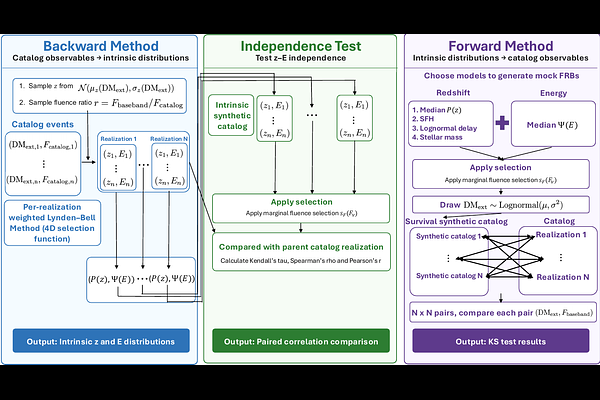
AbstractFast radio bursts (FRBs) are luminous extragalactic radio transients whose physical origins remain uncertain. Using over one thousand non-repeating events from CHIME/FRB Catalog 2, we infer the intrinsic FRB demographics with a self-consistent framework that combines backward non-parametric inference and forward population synthesis while accounting for probabilistic dispersion measure--redshift estimates, baseband-to-catalog fluence corrections, and the latest fuzzy multidimensional selection function. We first apply a backward non-parametric method, the weighted Lynden--Bell $C^{-}$ estimator, to recover the intrinsic redshift and energy distributions without assuming any population model. Independently, we perform forward Monte Carlo population synthesis in observable dispersion measure--fluence space, treating candidate intrinsic redshift and energy distributions as population hypotheses and comparing the resulting selected synthetic catalogs with observations. We find that the intrinsic redshift distribution peaks at $z\sim1$, significantly lower than the cosmic star formation history (SFH) peak at $z\sim1.7$, indicating clear tension with a pure SFH-tracking scenario, suggesting that at least some FRBs are delayed with respect to SFH. The intrinsic energy distribution is consistent with a power law of index $α\approx1.9$ and steepens at higher energies. We find no significant evidence for a redshift-energy distribution correlation.