High population density limits predator access in Antarctic fur seal breeding colonies

High population density limits predator access in Antarctic fur seal breeding colonies
Bartl, J.; Berthelsen, A. L.; Winterl, A.; Fox-Clarke, C.; Forcada, J.; Nagel, R.; Hoffman, J.; Fabry, B.
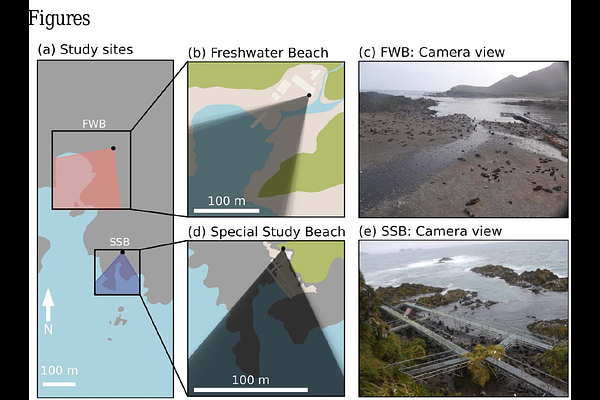
AbstractPopulation density can influence individual predation risk in colonial breeders through shared vigilance and predator deterrence. We investigated how predator-prey interactions are shaped by population density at two Antarctic fur seal (Arctocephalus gazella) breeding colonies at Bird Island, South Georgia, which differ four-fold in seal density. By deploying autonomous time-lapse cameras, we captured high-resolution images at one-minute intervals throughout the breeding season. Using a YOLOv8 neural network, we identified fur seal adult males, females and pups, as well as three predator-scavenger bird species: giant petrels (Macronectes spp.), brown skuas (Stercorarius antarcticus) and snowy sheathbills (Chionis alba). Abundance patterns corresponded to the known foraging and breeding behaviours of these species. Differences in seal density between the colonies were mainly driven by adult females and their pups, but not adult males. The ratios of predatory birds to pups were markedly lower at the high-density colony, while scavenger to pup ratios remained similar. Spatial analyses revealed that predators were largely excluded from areas of high seal density, whereas scavengers overlapped extensively with pups in both colonies. This study demonstrates the value of remote observation in resolving predator-prey interactions and illustrates how density can shape predation risk in a colonial breeder.