Mechanistic Modeling of Intrinsic Drug Resistance in Prostate Cancer Apoptosis Signaling

Mechanistic Modeling of Intrinsic Drug Resistance in Prostate Cancer Apoptosis Signaling
Mangrum, D. S.; Finley, S. D.
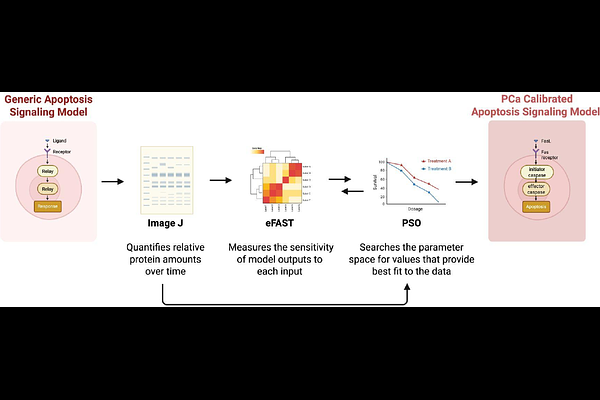
AbstractAnticancer drug resistance is challenging to overcome because it can arise through both intrinsic and acquired mechanisms, each driven by distinct cellular machinery. In particular, there is a sharp need for therapies that target hormone-insensitive prostate tumors due to the growing incidence of castration-resistant prostate cancer. Optimizing the pathways that regulate apoptosis in prostate cancer offers a promising strategy to induce apoptosis and inhibit tumor progression, since these mechanisms do not depend on hormonal signaling. Here, we identified strategies to enhance apoptosis in prostate cancer cells. We used several computational tools (including sensitivity analysis, particle swarm optimization, and ImageJ) to design an ordinary differential equation model of caspase-mediated prostate cancer apoptosis signaling. We apply the model to identify key modalities that increase the propensity toward apoptosis across three separate pro-apoptotic drugs (Tocopheryloxybutyrate, Narciclasine, and Celecoxib). Overall, we demonstrate that apoptosis dynamics can be accurately captured in response to each of the three drugs and identify which features of the model represent viable targets for overcoming intrinsic drug resistance.