Hoxb5+ fetal liver hematopoietic stem cells establish lifelong hematopoiesis and exhibit enhanced ITGA4-dependent engraftment

Hoxb5+ fetal liver hematopoietic stem cells establish lifelong hematopoiesis and exhibit enhanced ITGA4-dependent engraftment
Banuelos, A.; Baez, M.; Yılmaz, L.; Koren-Sedova, E.; Zhang, A.; Zukowska, M.; Womack-Gambrel, N.; Moffitt, M.; Burden, A. T.; Mascetti, V. L.; Honjol, R.; Xiang, J.; Sinha, R.; Weissman, I. L.
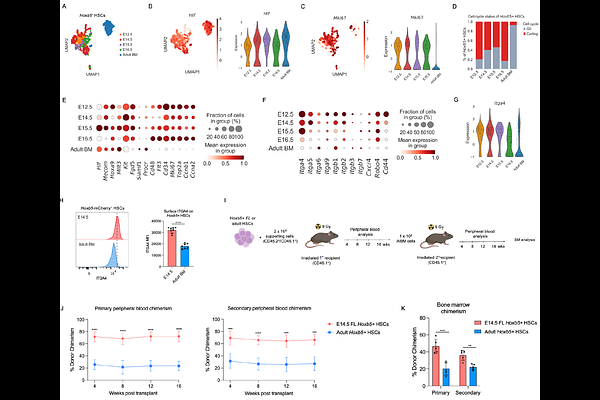
AbstractAdult long-term hematopoietic stem cells (LT-HSCs) are classically defined by self-renewal, multilineage regenerative capacity, and relative quiescence, but how and when lifelong LT-HSCs are established during development remains unclear. Here, we demonstrate that Hoxb5 fetal liver HSCs exhibit bona fide LT-HSC activity, including long-term multilineage reconstitution and serial transplantation capacity, whereas Hoxb5- fetal liver HSCs display limited regenerative potential. Embryonic lineage tracing further demonstrates that E14.5 Hoxb5-expressing hematopoietic cells contribute broadly to adult hematopoiesis, including the adult HSC compartment, and give rise to functional adult LT-HSCs. Across developmental stages, single-cell transcriptional profiling revealed that fetal Hoxb5 HSCs remain highly proliferative while maintaining canonical LT-HSC transcriptional programs and superior repopulating activity relative to predominantly quiescent adult Hoxb5 HSCs. Fetal Hoxb5 HSCs also exhibited elevated ITGA4-mediated adhesion programs, and disruption of the ITGA4-VCAM1 axis impaired engraftment following transplantation. Together, these findings establish a developmental continuum linking fetal and adult LT-HSCs and identify enhanced ITGA4-mediated adhesion as a defining feature of fetal LT-HSCs.