The projection basis determines the information ceiling for perturbation prediction

The projection basis determines the information ceiling for perturbation prediction
BIANCO, S.
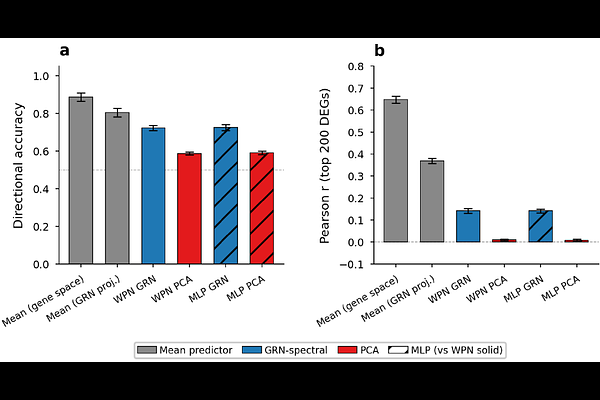
AbstractRecent benchmarks show that deep-learning models for perturbation prediction do not outperform simple baselines operating in principal-component (PCA) space. We explain this with an information-theoretic ceiling: for any orthonormal projection basis Phi, the squared correlation between prediction and truth is bounded by the variance the basis explains (r2 [≤] VE), so no model complexity can recover signal discarded at projection. On chemical perturbations (sciPlex3, LINCS L1000), the eigenbasis of a gene association network captures only 10-12% of drug-response variance and yields chance-level predictions, while PCA captures 90-99%. Graph wavelets built on the same network recover approx. 88%, localising the drug signal in high-frequency modes that the standard low-pass eigenbasis discards. On CRISPRa genetic perturbations the ranking inverts: the network basis outperforms PCA across all dimensions tested. Controls on topology, null networks and data leakage confirm the effect is structural. The right basis depends on the perturbation modality: PCA captures the variance that drives chemical responses, the network basis captures the cascade structure that drives genetic ones, and bases that access the network's full graph spectrum (such as graph wavelets) recover both from the same topology.