Rotation-induced Relaxation of Supernova Constraints on Axionlike Particles

Rotation-induced Relaxation of Supernova Constraints on Axionlike Particles
Tsurugi Takata, Kanji Mori, Ko Nakamura, Kei Kotake
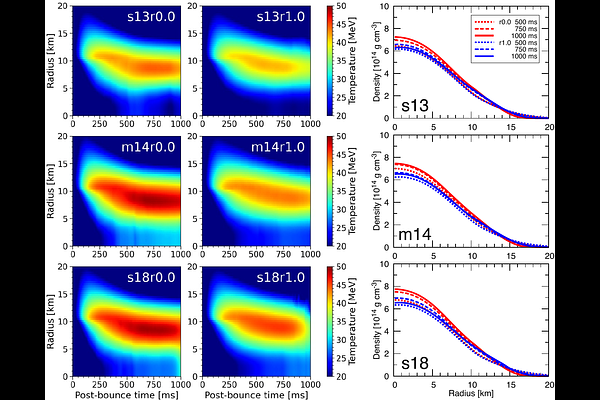
AbstractWe study how rotation modifies the constraints on MeV-scale axion-like particles (ALPs) coupled to photons derived from SN 1987A. We constrain the ALP parameter space based on both the energy-loss argument and the gamma-ray limits, and examine how these constraints are affected by stellar rotation. Adopting initial angular velocities of $Ω_{0} = 0.0 and 1.0 rad s^{-1}$ in the iron core, we carry out two-dimensional core-collapse supernova simulations for three progenitor models - a $14 + 9M_{\odot}$ binary and $13M_{\odot}$ and $18M_{\odot}$ single stars with solar metallicity - and estimate ALP emission rates through post-processing. We find that rotation suppresses ALP emission by reducing the core temperature via centrifugal support. Rotation also reduces the neutrino luminosity, but the suppression of ALP emission is more effective, leading to relaxed constraints within a simplified criterion based on the energy-loss argument. This relaxation is particularly pronounced in the rotating $18M_{\odot}$ model, where a substantial decrease in the central temperature occurs at $t_{pb} = 0.8 - 1 s$. In this simplified criterion, such rapid temporal variations in temperature indicate that the resulting constraints depend sensitively on both the evaluation time and the underlying supernova model. For a gamma-ray limit from the SN 1987A observation, rotation has a negligible impact on the constraint. This is because the ALP-induced gamma-ray fluence observed at Earth is proportional to the fourth power of the ALP-photon coupling constant, making the constraint relatively insensitive to the rotational suppression of ALP emission.