Readable Minds: Emergent Theory-of-Mind-Like Behavior in LLM Poker Agents

Readable Minds: Emergent Theory-of-Mind-Like Behavior in LLM Poker Agents
Hsieh-Ting Lin, Tsung-Yu Hou
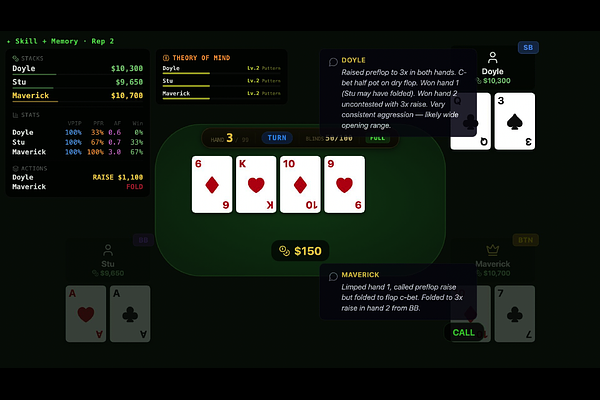
AbstractTheory of Mind (ToM) -- the ability to model others' mental states -- is fundamental to human social cognition. Whether large language models (LLMs) can develop ToM has been tested exclusively through static vignettes, leaving open whether ToM-like reasoning can emerge through dynamic interaction. Here we report that autonomous LLM agents playing extended sessions of Texas Hold'em poker progressively develop sophisticated opponent models, but only when equipped with persistent memory. In a 2x2 factorial design crossing memory (present/absent) with domain knowledge (present/absent), each with five replications (N = 20 experiments, ~6,000 agent-hand observations), we find that memory is both necessary and sufficient for ToM-like behavior emergence (Cliff's delta = 1.0, p = 0.008). Agents with memory reach ToM Level 3-5 (predictive to recursive modeling), while agents without memory remain at Level 0 across all replications. Strategic deception grounded in opponent models occurs exclusively in memory-equipped conditions (Fisher's exact p < 0.001). Domain expertise does not gate ToM-like behavior emergence but enhances its application: agents without poker knowledge develop equivalent ToM levels but less precise deception (p = 0.004). Agents with ToM deviate from game-theoretically optimal play (67% vs. 79% TAG adherence, delta = -1.0, p = 0.008) to exploit specific opponents, mirroring expert human play. All mental models are expressed in natural language and directly readable, providing a transparent window into AI social cognition. Cross-model validation with GPT-4o yields weighted Cohen's kappa = 0.81 (almost perfect agreement). These findings demonstrate that functional ToM-like behavior can emerge from interaction dynamics alone, without explicit training or prompting, with implications for understanding artificial social intelligence and biological social cognition.