Spiral-on-a-Curve: wireless photoacoustic neuromodulation patch

Spiral-on-a-Curve: wireless photoacoustic neuromodulation patch
Zhang, S.; gao, f.; Jiang, D.; Lan, H.
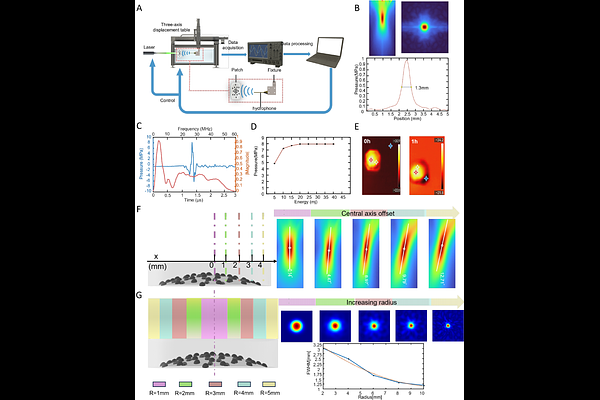
AbstractFocused ultrasound neuromodulation offers a promising noninvasive strategy for precise deep-brain stimulation, yet conventional piezoelectric phased arrays rely on bulky hardware, high-voltage electronics, and complex phase control, limiting their scalability and wearable integration. Photoacoustic approaches enable wireless ultrasound generation but remain constrained by a trade-off between focusing precision, penetration depth, and robustness to optical misalignment. Here, we present a geometrically encoded passive photoacoustic patch (PPP) based on a spherical double logarithmic spiral (SDLS) array that achieves intrinsically stable and programmable acoustic focusing without electronic phase modulation. By distributing hemispherical CNT/PDMS photoacoustic emitters quasi-uniformly over an equal-path spherical surface and orienting each emitter toward a predefined focal point, the device establishes geometry-dominated wavefront convergence. Numerical simulations demonstrate that curved geometry is a prerequisite for phase-free focusing, while the nonperiodic spiral topology suppresses sidelobes and mitigates interference artifacts Compared with continuous spherical or periodic concentric arrays, the SDLS architecture exhibits substantially enhanced robustness to optical axis displacement, reducing focal tilt from > 14{whitebullet} to approximately 5{whitebullet} under 2mm lateral misalignment. Experimental three-dimensional hydrophone mapping confirms millimeter-scale focusing at approximately 7mm depth with a full width at half-maximum of 1.3mm and peak pressures up to 8MPa under safe laser exposure ([≤] 20mJ/cm2). The focal region can be continuously tuned by adjusting illumination aperture size without altering device geometry or excitation schemes. The patch demonstrates excellent thermal and acoustic stability during prolonged operation and enables region-specific motor cortex stimulation in vivo, eliciting distinct electromyographic responses in forelimb and hindlimb muscles. By shifting ultrasound beam formation from electronic phase control to intrinsic three-dimensional geometry, this work establishes a lightweight, wire-free, and optically programmable platform for robust wearable neuromodulation and scalable bioacoustic interfaces.