Chandra X-ray Observations of the Pulsar Wind Nebula within CTA 1

Chandra X-ray Observations of the Pulsar Wind Nebula within CTA 1
Seth Gagnon, Oleg Kargaltsev, Jason Alford, Joseph Gelfand, Alexander Lange
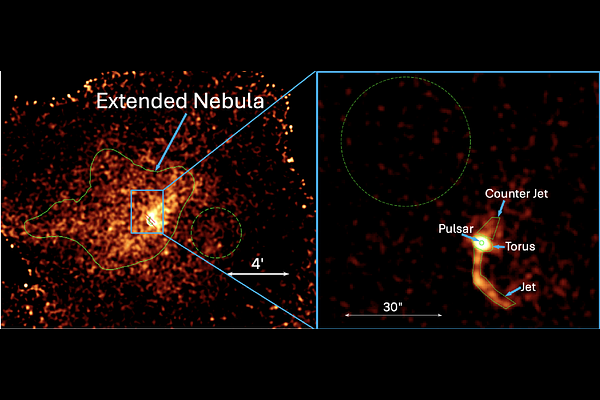
AbstractWe present deep Chandra observations of the pulsar wind nebula (PWN) powered by PSR J0007+7303 in the composite supernova remnant CTA 1. The merged ACIS image shows a $\sim20''$ jet extending south of the pulsar and bending toward the southwest, a faint counter-jet to the north, and a compact torus oriented approximately perpendicular to the jet axis. Using an archival observation from 2003 we perform relative astrometry over a $\sim20$ yr baseline and constrain the pulsar's transverse velocity to $\lesssim 200~\mathrm{km~s^{-1}}$ at the distance of 1.4 kpc at 95% confidence. Spatially resolved spectroscopy shows hard spectra for the jet and torus (photon indicies $Γ\approx 1.2-1.4$) and a softer spectrum for the extended nebula ($Γ= 1.85 \pm 0.11$), indicating minimal radiative cooling in the compact regions. Modeling of the torus, associated with the termination shock, as an inclined circle yields a viewing angle $ζ\approx 50^\circ$. The outer gap and two-pole caustic pulsar emission models then imply a moderate magnetic inclination ($α\sim 20^\circ$-$70^\circ$). Broadband spectral energy distribution (SED) modeling from radio to PeV $γ$-rays for a one-zone leptonic scenario yields a low magnetic field ($B \approx 1.4$-$3.2~μ\mathrm{G}$) and a high electron cutoff energy ($E_{\rm cut} \sim 0.2$-$0.3~\mathrm{PeV}$), indicating that the magnetic field decreases rapidly outside of the compact nebula. These results establish CTA 1 as a young, low X-ray efficiency PWN with a hard injection spectrum capable of accelerating particles to PeV energies.