Stage-adaptive integration of polydopamine promotes hPSC-derived alveolar organoids differentiation and maturation

Stage-adaptive integration of polydopamine promotes hPSC-derived alveolar organoids differentiation and maturation
Lan, R.; Chen, Y.; Liao, Z.; Zhang, H.; Zhong, C.; Yin, J.; Du, C.; Xu, T.; Meng, H.; Liu, H.
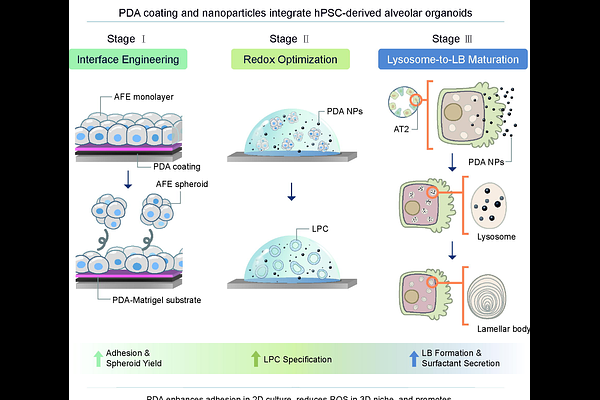
AbstractHuman pluripotent stem cell (hPSC)-derived alveolar organoids (ALOs) have emerged as a powerful tool for modeling human lung development and disease, and accelerating respiratory drug discovery. However, achieving the functional maturation of ALOs remains challenging. Polydopamine (PDA) is a mussel-inspired polyphenolic biomaterial with antioxidant and adhesive properties that can be deployed as surface coatings and nanoparticles (NPs) in cell culture systems. Here, we integrate PDA coatings and NPs sequentially in a stage-adaptive manner throughout the hPSC-derived ALOs differentiation system and study their contributions to ALOs maturation. Our results demonstrated PDA coating enhanced Matrigel-substrate attachment, increasing the yield of anterior foregut endoderm (AFE) spheroids. Bulk RNA-seq revealed upregulation of cell-cell and cell-extracellular matrix interactions by PDA. PDA NPs were encapsulated in Matrigel during AFE to lung progenitor cells (LPCs) differentiation, PDA mitigated reactive oxygen species (ROS) accumulation and enhanced LPCs generation. During ALOs maturation, suspended PDA NPs were internalized and participated lysosome-to-lamellar body biogenesis, which functionally improved AT2 maturation. Transcriptomics further indicated enrichment of endocytic-phagosome and epithelium development pathways by PDA treatment. Together, our study establishes a stage-adaptive-integrated PDA strategy throughout hPSC-to-ALOs differentiation and demonstrates that PDA robustly enhances ALOs maturation and secretory function.