Small-molecule CBLB inhibitor abolishes EGFR ubiquitination, reduces receptor endocytosis and diminishes cell motility signaling

Small-molecule CBLB inhibitor abolishes EGFR ubiquitination, reduces receptor endocytosis and diminishes cell motility signaling
Pinilla-Macua, I.; Mukerji, R.; Cohen, F.; Sorkin, A.
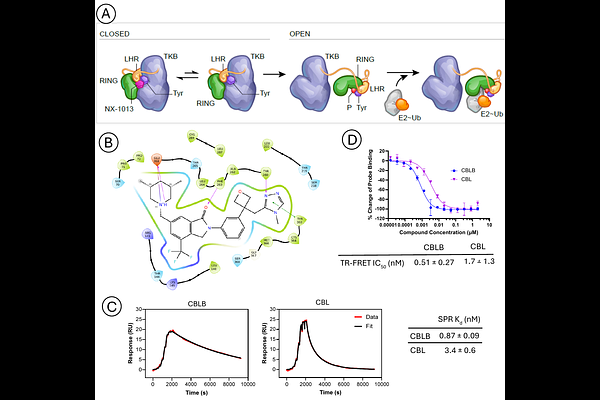
AbstractEndocytosis of the epidermal growth factor receptor (EGFR) is considered a key regulator of the receptor signaling activity. However, the molecular mechanisms underlying EGFR endocytosis are incompletely understood. Although ligand-induced ubiquitination of EGFR is known to promote its endocytic trafficking, the importance of EGFR ubiquitination in clathrin-mediated endocytosis, the primary physiological route of EGFR internalization, remains debated, and the relative contributions of ubiquitination-dependent and -independent mechanisms are not defined. Hence, we used NX-1013, a novel small-molecule inhibitor of the CBLB E3 ubiquitin ligase, to dissect the role of EGFR ubiquitination in its endocytic trafficking and signaling. Strikingly, brief treatment with NX-1013 completely abolished EGF-induced EGFR ubiquitination, demonstrating that this process is exclusively mediated by the closely related CBLB and CBL ligases. NX-1013 inhibited clathrin-mediated internalization of activated EGFR by 60-70%. The remaining, ubiquitination-independent internalization required EGFR kinase activity, was highly clathrin-dependent, and was significantly impaired by depletion of the AP-2 clathrin adaptor complex. Interestingly, inhibition of CBLs and EGFR endocytosis by NX-1013 did not affect major downstream signaling pathways in human oral squamous cell carcinoma cells, with the exception of Rac1 activation and EGFR-dependent cell migration, both of which were suppressed.