Cortical population codes for embedding sensory inputs into the prior context

Cortical population codes for embedding sensory inputs into the prior context
Hachen, I.; Reinartz, S.; Stroligo, A.; Pequeno Zurro, A.; Diamond, M. E.
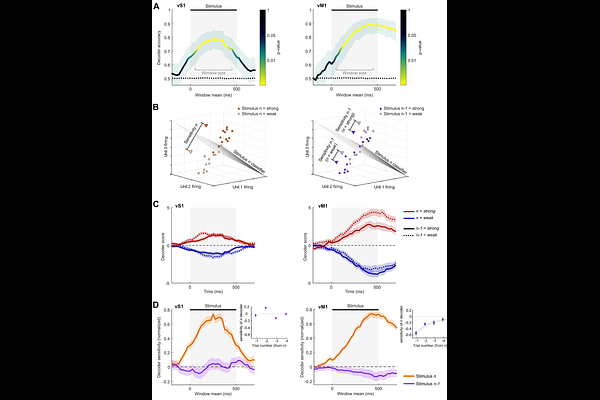
AbstractAccording to theories of the brain as a predictive network, perceptual decisions result from integrating incoming sensory inputs with prior experience. A neuronal population implementing this form of computation must not only retain information about past events, but also combine this information with current sensory evidence. To examine how this integration occurs, we recorded extracellular activity from both primary sensory cortex and a target frontal region in rats performing stimulus categorization. Psychophysical analysis showed that judgments were history-dependent. Sensory cortex represented the current stimulus largely independently of prior stimuli and failed to account for the history-dependence seen in behavior. By contrast, frontal cortex embedded current input within a representation of prior sensory information through collinearity in coding dimensions. This mechanism - predominantly mediated by fast-spiking neurons - explained trial-to-trial variability in decisions. Our findings argue for distinct roles of cortical regions in predictive processing, and identify a frontal stage where current and prior sensory information converge to inform decisions.