Growth, survival, and fitness in the first year of life for Pycnopodia helianthoides under different larval densities

Growth, survival, and fitness in the first year of life for Pycnopodia helianthoides under different larval densities
Lopez-Nandam, E. H.; Story, L. T.; Evin, M.; Witherly, J.; Upton, M.; Krol, L.; Dunker, F.; Lev, K.
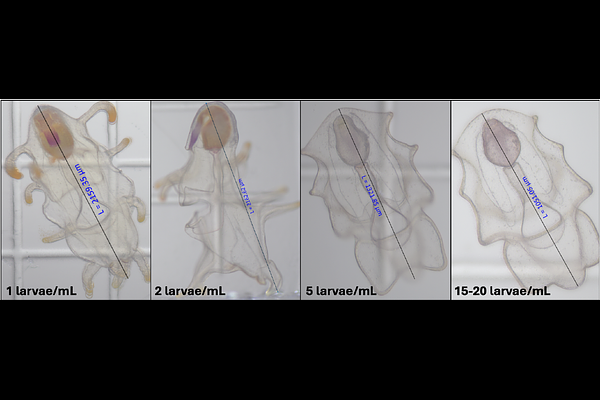
AbstractSea star wasting disease has caused widespread mortality in the kelp forest predator, the sunflower sea star ( Pycnopodia helianthoides ). Wild populations have declined by up to 99% in parts of their native range along the western North American coast. In response, a multi-institutional conservation breeding and rearing program has been initiated to support future reintroduction efforts for the species. We split a full-sibling cohort across four larval density treatments (1 larva/ml, 2 larvae/ml, 5 larvae/ml, and 15-20 larvae/ml) to assess the effects on larval settlement, juvenile survival, and juvenile fitness at 12 months old. Stars raised in the highest density treatment displayed a lower settlement rate and were significantly smaller than the other density groups at 12 months old, but showed no significant difference in flip time, a measure of fitness. Additionally, measurements of diameter, weight, and arm count across modern and historical juvenile and adult stars indicate that P. helianthoides experience exponential weight gain as they grow in length, with corresponding asymptotic growth in arm count. These findings will inform best practices for the aquarium propagation of P. helianthoides and will contribute to broader efforts aimed at reestablishing populations in the wild.