Cystinosin/Ers1 functions in redox homeostasis in the early secretory pathway

Cystinosin/Ers1 functions in redox homeostasis in the early secretory pathway
Zhu, J.; Mosale, S.; Bowerman, J.; Baik, S.; Munechika, K.; Wu, N.; Skirycz, A.; Yu, H.; Pineros, M.; Sardana, R.
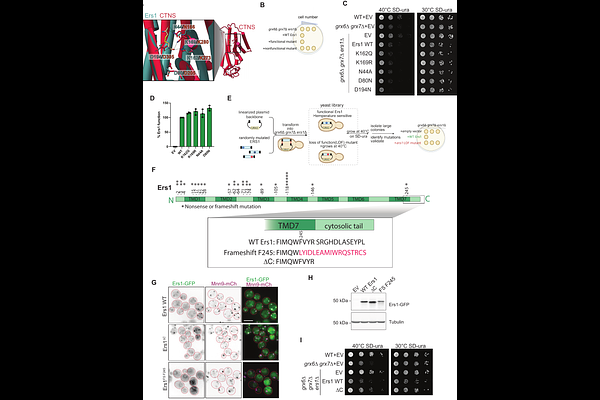
AbstractCystinosis is an autosomal recessive inherited disorder caused by mutations in the CTNS gene, which encodes the highly conserved transmembrane protein cystinosin, a proton/cystine co-transporter at the lysosome membrane. However, reduction of cystine load in the lysosomes is insufficient to treat key disease symptoms, indicating that cystinosin performs additional disease-relevant functions. Here, we report that Ers1, the yeast homolog of cystinosin, localizes to and functions in the early secretory pathway. We provide evidence that Ers1 does not transport cystine. Ers1 genetically interacts with early secretory pathway recycling adaptors and redox-active Fe-S cluster-binding proteins. Notably, cystinosin-LKG, the extra-lysosomal localized splicing isoform of cystinosin, can functionally replace Ers1 in yeast. Collectively, our work uncovers a conserved role of cystinosin/Ers1 in the early secretory pathway, offering new molecular insights for understanding cystinosis pathology.