Tetrodotoxin-resistant NaV1.8 contributes to action potential conduction in a population of mouse and human vagal nerve fibers

Tetrodotoxin-resistant NaV1.8 contributes to action potential conduction in a population of mouse and human vagal nerve fibers
Nair, S. S.; Taylor-Clark, T. E.
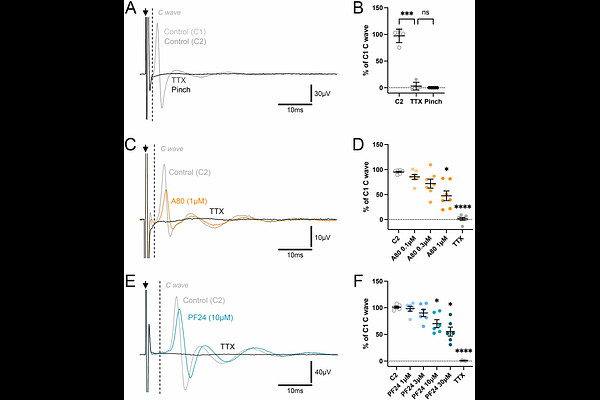
AbstractAxonal action potential (AP) conduction is dependent on voltage-gated sodium channels (NaV1s). AP conduction in the vagus nerve (which contains afferent and efferent fibers) is essential to its reflex regulation of most visceral organs. The nine isoforms of NaV1s show diverse expression patterns in vagal neurons. In rodent vagus nerves, multiple NaV1 isoforms contribute to AP conduction, with NaV1.7 playing an essential role in ~70% of fibers. Here, we investigated the contribution of tetrodotoxin-resistant (TTX-R) NaV1.8 towards vagal AP conduction ex vivo. We tested two structurally different NaV1.8-selective inhibitors, A803467 and PF01247324 and their effects on electrically evoked C-fiber compound action potentials (CAPs) along mouse and human vagus nerves. Tetrodotoxin completely abolished mouse and human vagal CAPs. Nevertheless, both A803467 and PF01247324 caused a concentration-dependent decrease in the C-fiber CAPs in mouse and human vagus nerves. The selectivity of both drugs was tested in NaV1.8 knockout mice. A803467 but not PF01247324 significantly decreased NaV1.8 KO vagal CAPs, indicating that PF01247324's inhibition of wildtype vagal CAPs was solely mediated by NaV1.8, and that A803467 caused inhibition via NaV1.8-mediated and non-NaV1.8-mediated mechanisms. In further studies of wildtype mice, NaV1.8 inhibition following incubation with NaV1.7-selective inhibitor PF05089771 showed no further decrease in mouse vagal CAP, demonstrating that NaV1.8-dependent inhibition affects fibers also sensitive to NaV1.7-dependent inhibition. These data suggest that TTX-sensitive NaV1.7 and TTX-R NaV1.8 cooperate to conduct APs along a select population of vagal nerves. Axonal NaV1.8 inhibition could be utilized to treat aberrant vagal nerve activity in visceral organ diseases.