Angular leaf spot in Acmella oleracea caused by a foliar nematode

Angular leaf spot in Acmella oleracea caused by a foliar nematode
Silva, M. d. F.; Faccioli, F. C.; Honorio, A. P.; Fonseca, A. R.; Boari, A. d. J.; Buonicontro, D. S.
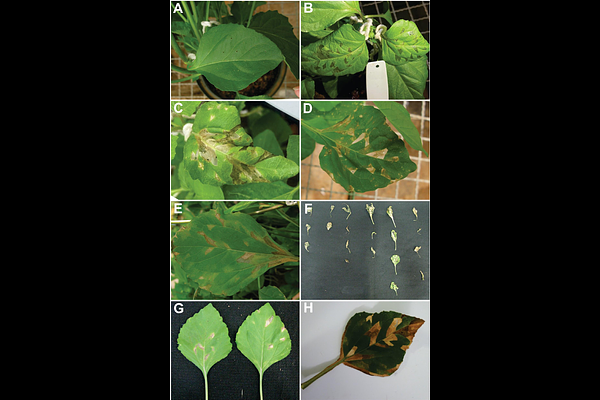
AbstractJambu plants (Acmella oleracea) exhibiting necrotic angular leaf spots were collected in Belem - Para, Brazil. After previous analysis, the presence of nematodes from Aphelenchoides genus was observed. These nematodes were cultured on Fusarium sp. and subsequently morphologically and molecularly characterized for species-level identification. Aphelenchoides sp. associated with jambu exhibited morphological and morphometric characteristics very similar to those of species within the A. besseyi complex (A. besseyi, A. oryzae and A. pseudobesseyi), but these characteristics were not sufficient to separate them into a unique species. The Bayesian inference analysis, utilizing the expansion segment of the large subunit (D2-D3 LSU) of nuclear ribosomal DNA, yielded results with a high posterior probability, indicating that the Aphelenchoides sp. associated with jambu belongs to the A. pseudobesseyi species. Under controlled conditions, the reproduction of the nematode in the leaf tissues (FR > 1) was observed, resulting in disease symptoms. The highest reproduction rate of A. pseudobesseyi (FR = 2.6) was observed from inoculation with 100 nematodes per leaf. It is concluded that A. pseudobesseyi is the etiological agent of jambu angular leaf spot. For future research, like evaluating the resistance of jambu to this nematode, it is recommended to inoculate a maximum of 100 nematodes per leaf.