Extraction method for response functions from X-ray light curves of AGN by optimization algorithm

Extraction method for response functions from X-ray light curves of AGN by optimization algorithm
Sanhanat Deesamutara, Tirawut Worrakitpoonpon, Poemwai Chainakun, Wasutep Luangtip, Jiachen Jiang, Francisco Pozo Nuñez, Andrew J. Young
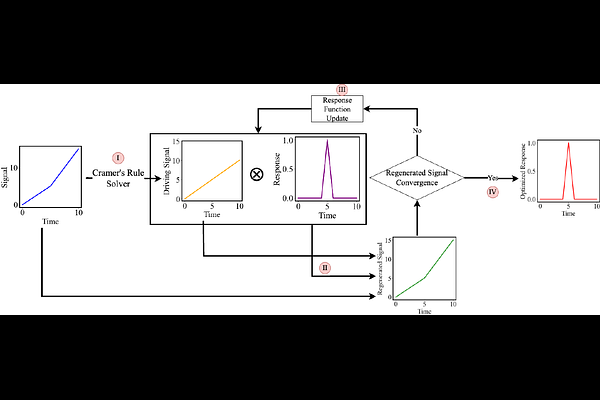
AbstractWe introduce a numerical optimization method to extract the X-ray reverberation response functions from the multi-band light curves of the active galactic nuclei. This approach does not require prior assumptions about the accretion disc and corona geometry, provided that the light curves result from the superposition of direct and singly-convolved signals, consistently across all bands. By reformulating the light curve equations into the matrix form, the optimal response matrix is derived by minimizing the squared difference between the observed and reconstructed light curves using a gradient-based optimization algorithm. We demonstrate that the method can robustly accommodate up to two convolution processes, such as the reverberation and the propagation, simultaneously. When tested on the synthesized light curves, the method demonstrates robustness of the solutions to variations in the relative contributions of each light curve component as the recovered response kernel remains acceptably close to the ground truth, as evaluated by both the response geometry and the reconstructed light curves. The method's tolerance to random noise was also assessed. With appropriate denoising, the response kernel can be reliably recovered when the signal-to-noise ratio is at least $100$. We show, as a proof of concept, that the proposed method is geometrical-model independent and has the potential to offer a flexible complement to traditional approaches.