DLS: Dual-Logic Graph Neural Networks with Chaos-Fuzzy Residuals for Robust Link Prediction

DLS: Dual-Logic Graph Neural Networks with Chaos-Fuzzy Residuals for Robust Link Prediction
Mohammad Mehdi Keikha, Abolfazl Nadi
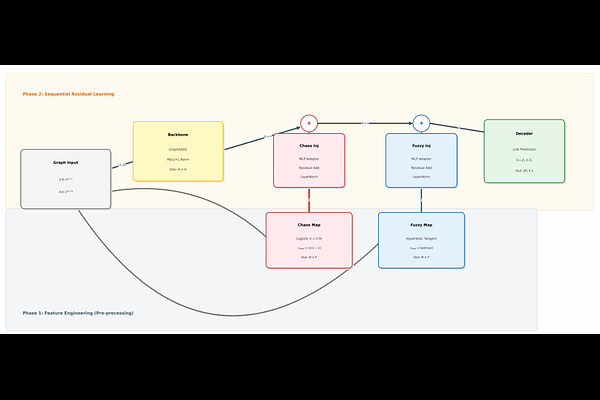
AbstractLink prediction is a fundamental task in graph mining, critical for applications ranging from biological interaction discovery to recommender systems. While Message Passing Neural Networks (MPNNs) have achieved state-of-the-art results, they are fundamentally limited by the inadvertent suppression of high-frequency signals, as the recursive aggregation that stabilizes structural learning inherently leads to over-smoothing, rendering node representations indistinguishable in deep layers. This limitation is particularly severe in heterophilous graphs, where structural proximity does not imply feature similarity. In this paper, we propose DLS (Dual-Logic SAGE), a novel inductive framework designed to break the over-smoothing barrier via a "controlled instability" mechanism. Unlike conventional methods relying on static structural heuristics, DLS introduces a dynamic residual pipeline. First, a Chaotic Injection Module utilizes the Logistic Map to diversify the feature manifold, exploiting sensitivity to initial conditions to separate topologically similar but semantically distinct nodes. Second, to mitigate the aleatoric uncertainty introduced by chaotic dynamics, a Fuzzy-Logic Gating Mechanism applies soft-thresholding to filter noise and retain only high-confidence signals. Experimental results on diverse benchmarks demonstrate that DLS effectively balances feature discrimination with robustness, significantly outperforming state-of-the-art baselines in heterophilous settings while maintaining competitive efficiency on standard homophilous graphs.