Estimating Muscle Parameters via Hierarchical Bayesian Inference

Estimating Muscle Parameters via Hierarchical Bayesian Inference
Johnson, R. T.; Yu, Y.; Darmon, Y.; Barradas, V. R.; Schweighofer, N. T.; Finley, J.
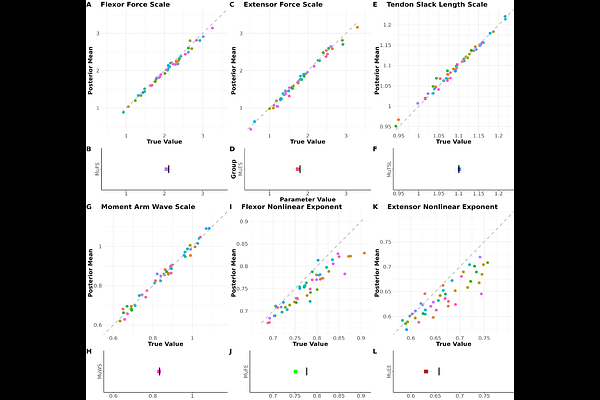
AbstractMusculoskeletal models are widely used to relate muscle mechanics to movement patterns in biomechanics. Accurate estimation of muscle parameters is essential for building individualized models, yet most rely on generic parameters derived from cadaveric data that do not reflect subject-specific properties critical to force generation. Here, we introduce a hierarchical Bayesian framework that leverages surface electromyography (EMG) and torque data from isometric elbow tasks to estimate subject-specific muscle parameters, overcoming limitations of generic parameter sets. This approach accounts for both inter-individual variability and uncertainty in measurement and model structure. The model infers six key parameters per subject, including flexor and extensor muscle strength, tendon slack length, moment arm geometry, and nonlinear EMG-to-activation relationships. We estimated model parameters for 14 young, healthy adults performing isometric elbow flexion and extension at multiple joint angles and torque levels. The six-parameter hierarchical-Bayesian musculoskeletal model accurately reproduced measured net elbow torque (R2 = 0.96) and outperformed simpler configurations. Muscle strength parameters varied substantially across individuals, from approximately 1.0 to 3.5. On average, participants exhibited about twice those of the OpenSim 26 generic model. In contrast, tendon slack length estimates varied minimally across subjects. Bilateral testing revealed moderate correlations between left- and right-arm parameters, supporting the models ability to capture subject-specific anatomical features. Cross-validation confirmed robust predictive performance, and convergence diagnostics indicated reliable sampling. Compared to traditional EMG-driven or imaging-based personalization methods, our approach quantifies uncertainty, enables partial pooling across subjects, and avoids reliance on invasive or time-intensive measurements. The framework is extensible to dynamic tasks and adaptable to clinical populations, including individuals post-stroke. These results demonstrate that hierarchical Bayesian inference can robustly personalize musculoskeletal models and advance our understanding of biomechanics.