Herbarium specimens reliably track plant phenological responses to climate change in understudied montane biomes

Herbarium specimens reliably track plant phenological responses to climate change in understudied montane biomes
Peng, S.; Inouye, B. D.; Ramirez-Parada, T.; Mazer, S. J.; Record, S.; Ellison, A. M.; Davis, C. C.
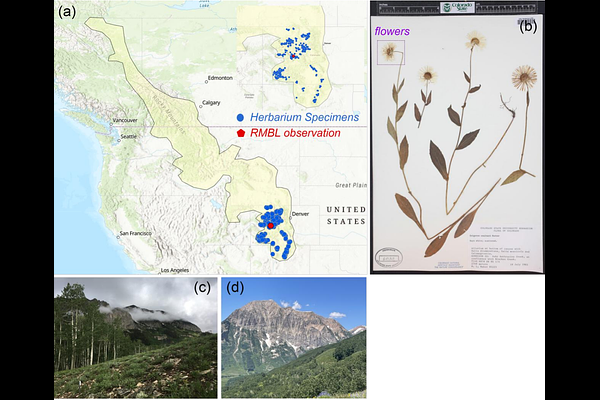
AbstractLong-term field observations typically are the "gold-standard" for inferences of phenological sensitivities in montane systems but are spatially limited. Herbarium specimens provide broader spatial coverage, but their utility to accurately capture montane phenology remains poorly known. We compared flowering phenology of 45 species inferred from herbarium specimens with comparable data from nearly 50 years of direct observations at the Rocky Mountain Biological Laboratory. Estimates of flowering time and phenological sensitivity to snow density were consistent between herbarium specimens and observations, but observations revealed secondary flowering peaks. Herbarium specimens additionally yielded shallower estimates of phenological sensitivity to spring temperature than did field observations. Across co-occurring species, "early" flowering individuals inferred from herbarium specimens, rather than the mean response across all individuals, may better approximate community-level phenological responses to temperature changes. We conclude that herbarium specimens are reliable resources for closing gaps in understanding phenological variation along elevational gradients of montane systems.