Walrus Population-specific Marine Reservoir Offsets (ΔR) for Calibration of Radiocarbon Dates: Implications for Arctic Chronologies and Medieval Trade

Walrus Population-specific Marine Reservoir Offsets (ΔR) for Calibration of Radiocarbon Dates: Implications for Arctic Chronologies and Medieval Trade
Philippsen, B.; Dierickx, K.; Falahati-Anbaran, M.; Kunisch, E. H.; Royle, T. C. A.; Sabin, R.; Barrett, J. H.
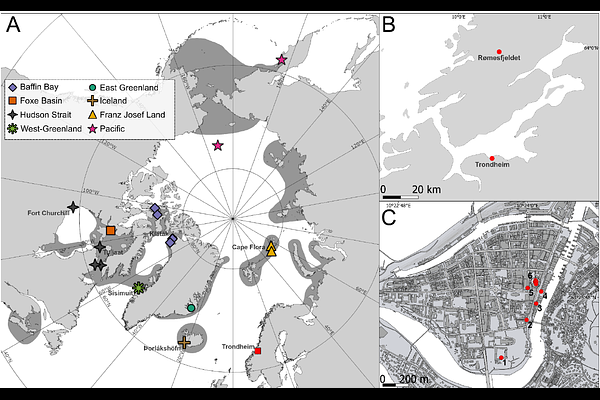
AbstractWalruses have long played a vital role in Arctic subsistence and commercial economies, yet accurate radiocarbon dating of walrus-derived archaeological materials is complicated by regional variation in marine reservoir effects. This study presents new {Delta}R values derived from 31 new and 15 legacy radiocarbon dates on known-age walrus specimens spanning multiple populations of Odobenus rosmarus rosmarus and O. r. divergens. The results reveal substantial inter-population variability, with {Delta}R values ranging from -140 (Franz Josef Land) to +295 (Pacific), underscoring the importance of population-specific calibration. A pooled {Delta}R of +17{+/-}12 was calculated for western Greenland and the Canadian Arctic--regions central to the medieval Norse ivory trade--and applied to 12 walrus rostra and ivory artefacts excavated in Trondheim, Norway. The resulting calibrated dates are from the 11th to early 14th centuries CE, confirming that seemingly anomalous post-15th-century finds are residual rather than evidence of continued trade. An alternative {Delta}R estimate of -110{+/-}35, derived solely from archaeological context dates, suggests potential time lags between harvest and deposition. These findings demonstrate the value of known-age walrus {Delta}R data for refining chronologies of Arctic exploitation and long-distance trade, while highlighting the need for provenance studies in archaeological dating and both the pertinence and limitations of mollusk-based reservoir corrections.