Hierarchical membrane-chromatin tethering buffers nuclear envelope assembly against alterations in lipid flux

Hierarchical membrane-chromatin tethering buffers nuclear envelope assembly against alterations in lipid flux
Barger, S.; Sepulveda, S.; Yang, H.; Goudge, M.; Lee, S.; Ridgway, N.; Bahmanyar, S.
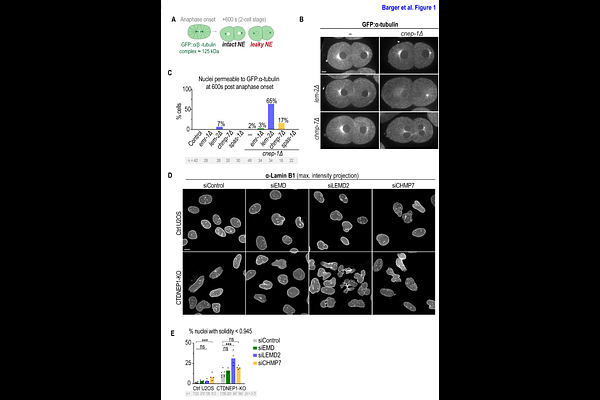
AbstractIn open mitosis, a single nuclear envelope (NE) forms around segregated chromosomes despite an excess of membrane-chromatin tethers. Here, we identify a hierarchical relationship between the BAF binding membrane tethers LEM-2 and Emerin, in which LEM-2 preferentially accumulates at BAF binding sites during postmitotic NE assembly and limits Emerin accumulation in C. elegans embryos. When LEM-2 is absent, Emerin occupies these sites and compensates for LEM-2 loss; however, NE formation becomes sensitized to ER membrane abundance - excessive phospholipid production through loss of CTDNEP1/CNEP-1 causes membrane invasions in interchromosomal regions and, across multiple systems, formation of lobulated, unstable nuclei with abnormal Emerin accumulations. We find that human CTDNEP1 regulates the NE-associated enzyme CCTa; to maintain phosphatidylcholine (PC) homeostasis through preventing delayed PC breakdown. Restoring PC levels rescues Emerin assembly and nuclear morphology defects resulting from the combined loss of CTDNEP1 and LEMD2. Together, these findings link membrane-chromatin tethering to ER lipid content and reveal preferential tethering as a determinant of NE assembly fidelity, with broad relevance to disease-related nuclear defects.