Discovery of a Supernova Following the Einstein Probe Transient EP250302a at z = 1.131

Discovery of a Supernova Following the Einstein Probe Transient EP250302a at z = 1.131
Brendan O'Connor, Malte Busmann, James Freeburn, Lei Hu, Noel Klingler, Daniel Gruen, Igor Andreoni, Julius Gassert, Xander J. Hall, Antonella Palmese
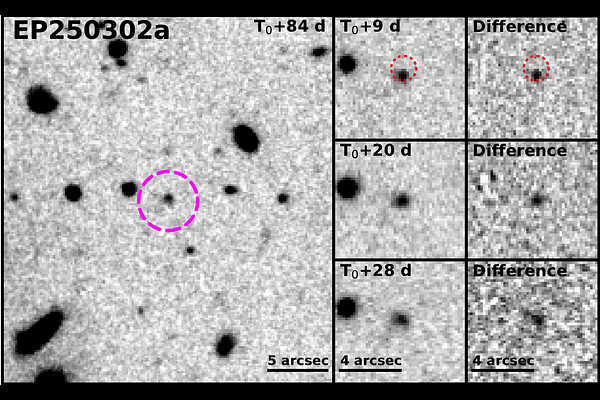
AbstractWe present a multi-wavelength analysis of the Einstein Probe (EP) fast X-ray transient (FXT) EP250302a located at redshift $z=1.131$. Despite its luminous prompt X-ray emission, the event was not detected in gamma-rays. Multi-wavelength follow-up identified a bright optical and X-ray source that displayed rapid chromatic flaring before returning to the standard decay of a gamma-ray burst afterglow. We interpret the chromatic flare as either due to a refreshed shock caused by a discrete shell collision or as reverse shock emission. Using the early optical data, we place constraints on the Lorentz factor of the outflow, requiring an ultrarelativistic jet with $Γ_0>25$. We additionally obtained deep late-time imaging with the Gemini North Telescope that reveals the presence of an optical excess at $20-30$ d post-explosion. We interpret this as supernova (SN) emission and find good agreement with the canonical broad-lined Ic SN 1998bw with a flux-scaling factor of $k_\textrm{98bw}>0.3$. This adds to the growing evidence that the majority of EP FXTs are associated with the deaths of massive stars.