Increased variability and reduced phenotypic robustness in clonal Drosophila mercatorum

Increased variability and reduced phenotypic robustness in clonal Drosophila mercatorum
Kahraman, A.; Wirth, M.; Hammoud, H.; Reslan, M.; Haidar, M. A.; Djuhadi, G.; Mathejzyk, T.; Reifenstein, E.; Balke, J.; von Kleist, M.; Linneweber, G. A.
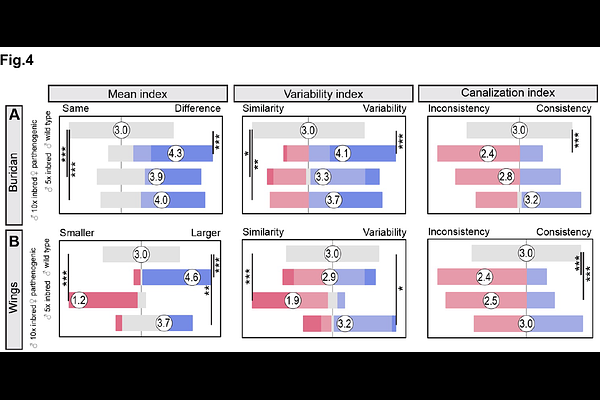
AbstractPhenotypic variation arises from the interplay of genetic, environmental, and stochastic developmental factors. Quantitative genetics predicts that reducing genetic variation through inbreeding or clonality should reduce phenotypic variation, an assumption that underlies the widespread use of inbred and clonal model organisms in biomedical research. Here, we test this assumption in the facultatively parthenogenic fly Drosophila mercatorum, in which parthenogenesis results in complete homozygosity and clonality after a single generation. Contrary to expectation, clonal parthenogenic flies showed broad shifts in trait means, altered interindividual variability, increased fluctuating asymmetry, and reduced behavioral and developmental canalization relative to sexually reproducing controls. Inbreeding reproduced substantial parts of this phenotype, whereas outcrossing restored robustness, identifying loss of heterozygosity as a major driver of the effect. Our findings show that extreme genetic uniformity can amplify rather than constrain stochastic phenotypic divergence, suggesting that controlled heterozygosity may, in some contexts, provide a more robust and reproducible experimental substrate than highly inbred, isogenic, or clonal animals.