COMPARATIVE GENOMIC ANALYSIS OF CORE AND ACCESSORY GENES IN RUST FUNGI REVEALS PATHOGENICITY-ASSOCIATED GENE FAMILIES IN Phakopsora pachyrhizi

COMPARATIVE GENOMIC ANALYSIS OF CORE AND ACCESSORY GENES IN RUST FUNGI REVEALS PATHOGENICITY-ASSOCIATED GENE FAMILIES IN Phakopsora pachyrhizi
Rocha, V. D. d.; Oliveira, L. S.; Guimaraes, F.
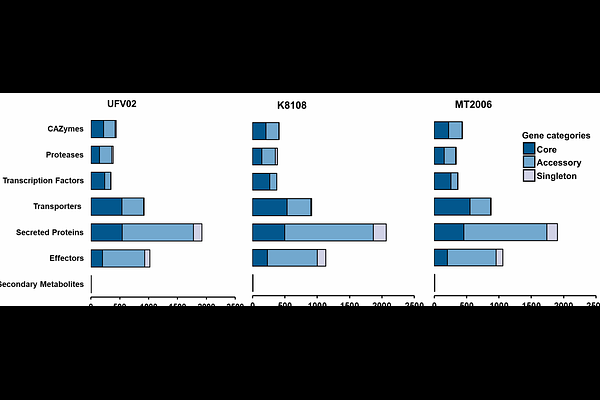
AbstractAccessory genes are thought to contribute to fungal adaptation and pathogenicity by modulating host immunity, while core genes play crucial roles in maintaining fundamental biological processes. Rust fungi (order Pucciniales) are obligate biotrophic plant-pathogens and infect economically relevant crops. Here, we characterize core and accessory gene repertoires across rust fungi, with a particular focus on Phakopsora pachyrhizi, the causal agent of Asian soybean rust. Across Pucciniales genomes, accessory genes represented the largest fraction of gene content (~44.6% on average), whereas core genes accounted for a smaller proportion (~18-35%). Notably, variations in accessory gene content among rust fungi are perhaps attributed to lineage-specific gene expansions and losses. Core gene content was positively correlated with total gene number across Pucciniales genomes, suggesting retention after gene duplication events, consistent with their essential biological functions. Among P. pachyrhizi genes expressed during soybean infection, core effectors were associated with cysteine-rich proteins, pectin-degrading enzymes, and SPFH/Band 7 family, while accessory effectors included phosphatidylethanolamine-binding proteins, trehalose phosphatases, and CFEM domain-containing proteins. The in-plant induced core and accessory genes in P. pachyrhizi also comprised multiple families of CAZymes (GH5/GH7 cellulases, CE5 cutinases, CE8 pectinesterases, CE4/GH18 chitin-modifying enzymes); proteases (aspartyl proteases, serine carboxypeptidases, alpha/beta hydrolases); transporters (amino acid permeases, ferric reductase-like transmembrane proteins, and OPT oligopeptide transporter), and transcription factors (bZIP, GATA zinc finger, STE-like, and homeobox KN). Our study highlights that core and accessory gene families have shaped P. pachyrhizi-soybean interactions, identifying promising targets for functional studies aimed at elucidating host-adaptation mechanisms in rust fungi.