Multi-wavelength insights into the pulsar wind nebula candidate near 1LHAASO J0343+5254u: an obscured merging galaxy cluster?

Multi-wavelength insights into the pulsar wind nebula candidate near 1LHAASO J0343+5254u: an obscured merging galaxy cluster?
H. W. Edler, M. Arias, A. Botteon, C. G. Bassa
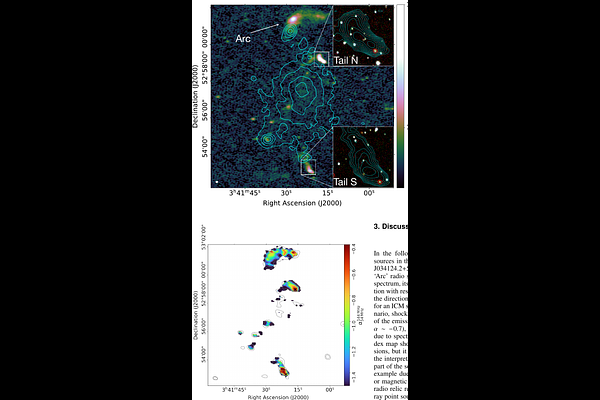
AbstractThe advent of the Large High Altitude Air Shower Observatory (LHAASO) accelerated the detection of TeV and PeV gamma-ray sources. Some of these are associated with pulsar wind nebulae (PWNe) and other Galactic objects, while others are yet to be connected to sources at other wavelengths. Recently, the discovery of an extended X-ray source within the unidentified PeV source 1LHAASO J0343+5254u was reported, this source was claimed as a candidate PWN based on its X-ray spectrum. We will revisit the interpretation of the extended X-ray source based on multi-wavelength observations. We present new LOFAR continuum radio imaging at observing frequencies of 54 and 144 MHz, an alternative X-ray modeling and archival near-infrared (NIR) data. We discover several radio sources with morphologies and spectra suggestive of a radio halo, a radio relic and tailed radio galaxies, all of which are typically found in (merging) galaxy clusters. Furthermore, we show that the X-ray data can be modeled as thermal emission from the intracluster medium (ICM), with our best-fitting thermal ICM model being slightly preferred to a non-thermal power-law fit. We further find a 9.7$σ$ over-density in red NIR sources in the surrounding region, among them possible hosts of the tailed radio sources. Our results favor an interpretation of the X-ray source as a massive, merging galaxy cluster located in a highly extinct region of the Galactic plane, unrelated to 1LHAASO J0343+5254u. Future observations in the hard X-ray regime will be able to conclusively settle the discussion on the nature of the X-ray emission.