Acclimation to thermal variability increases the intensity of activity and alters the activity window in the temperate dung beetle Onthophagus taurus

Acclimation to thermal variability increases the intensity of activity and alters the activity window in the temperate dung beetle Onthophagus taurus
Coverley, A. J.; Sheldon, K. S.; Marshall, K. E.
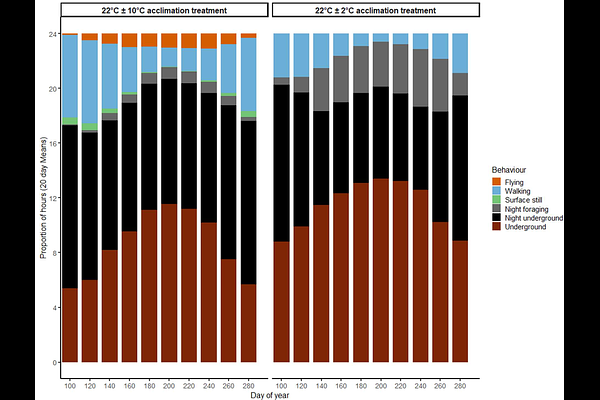
Abstract1. Ectotherms in thermally variable environments mediate energy expenditure through both physiological and behavioural responses. However, many studies focus on constant temperature acclimation, and few consider behaviour and physiology in unison. It is unclear how acclimation to thermal variability affects locomotory choices, activity timing, and performance across daily thermal cycles. 2. We investigated the effects of thermal variability in the temperate dung beetle Onthophagus taurus. Following acclimation to a low amplitude (22C +/- 2C) or a high amplitude (22C +/- 10C) temperature regime, we measured behaviour and metabolic rate across temperatures. We hypothesised that O. taurus adjusts its locomotive strategy and search window when kept in high amplitude fluctuating temperatures to reduce energy loss associated with high temperature exposure. 3. We found that differences in energy expenditure were determined by propensity for flight which differed between acclimation treatments, particularly at intermediate temperatures. We also found that, following acclimation to a high amplitude of thermal variability, O. taurus exhibited a greater intensity of activity over a narrower window of time, and O. taurus acclimated to a low amplitude of thermal variability showed nocturnal activity. 4. We then used the data to model activity through the growing season over five years. Biophysical models were built using NicheMapR Microclimate and Ectotherm functions to test the length of potential searching time across seasons, the temperatures individuals are exposed, and locomotive strategy. Model outputs showed that acclimation to higher amplitudes of thermal variability increased accumulated degree-hours of activity relative to the low variability acclimation group. Individuals acclimated to higher amplitudes of thermal variability showed greater accumulated degree-hours in spring and fall, but exhibited shorter periods of activity during summer, with the model predicting increased opportunities for flight. Comparatively, O. taurus from the low variability acclimation treatment showed increased night activity in summer but did not fly.