Methods for Implementing Integrated Step-Selection Functions with Incomplete Data

Methods for Implementing Integrated Step-Selection Functions with Incomplete Data
Hofmann, D. D.; Cozzi, G.; Fieberg, J.
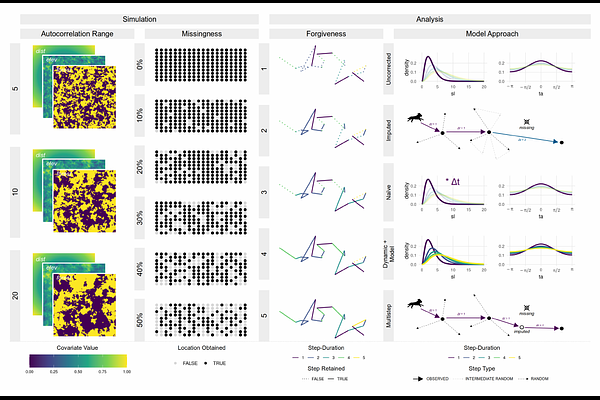
AbstractIntegrated step-selection analyses (iSSAs) are versatile and powerful frameworks for studying habitat and movement preferences of tracked animals. iSSAs utilize integrated step-selection functions (iSSFs) to model movements in discrete time, and thus, require animal location data that are regularly spaced in time. However, many real-world datasets are incomplete due to tracking devices failing to locate an individual at one or more scheduled times, leading to slight irregularities in the duration between consecutive animal locations. To address this issue, researchers typically only consider bursts of regular data (i.e., sequences of locations that are equally spaced in time), thereby reducing the number of observations used to model movement and habitat selection. We reassess this practice and explore four alternative approaches that account for temporal irregularity resulting from missing data. Using a simulation study, we compare these alternatives to a baseline approach where temporal irregularity is ignored and demonstrate the potential improvements in model performance that can be gained by leveraging these additional data.