Developmental regulation of kinetochore phosphorylation determines mitotic fidelity

Developmental regulation of kinetochore phosphorylation determines mitotic fidelity
Galaviz Sarmiento, B.; Compton, D. A.; Godek, K. M.
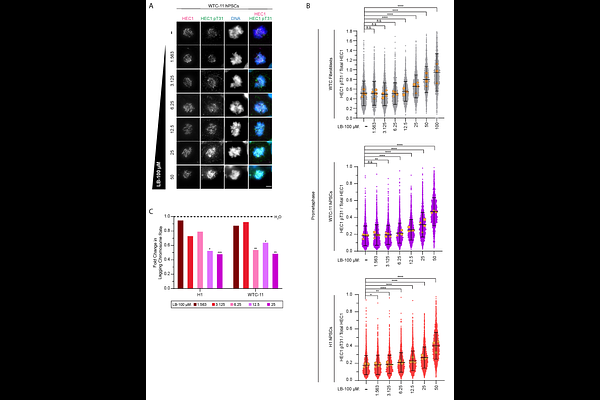
AbstractAccurate chromosome segregation relies on proper centromere and kinetochore formation and phospho-regulation. We previously demonstrated that a pluripotent state confers a low fidelity of chromosome segregation, however it is unknown how a pluripotent state impacts centromere and kinetochore function. Here, we demonstrate that both centromere and kinetochore structural organization and phosphorylation in mitosis are developmentally regulated. CENP-A, CENP-C, and HEC1 protein abundance is reduced at mitotic centromeres and kinetochores of human pluripotent stem cells (hPSCs) compared to isogenic somatic cells; however, elevating their levels does not improve chromosome segregation fidelity. Rather, we find that reduced phosphorylation of kinetochores is responsible for their low fidelity. HEC1 is hypophosphorylated at kinetochores of hPSCs compared to isogenic somatic cells at Cyclin B/Cdk1 and Aurora kinase phospho-sites. Inhibiting PP2A phosphatase activity or differentiation increases HEC1 phosphorylation at hPSC kinetochores decreasing chromosome segregation errors. Thus, mitotic fidelity in non-transformed human cells depends on the developmental regulation of the kinase and phosphatase networks controlling kinetochore phosphorylation.