Physics-informed stereology for estimating placental diffusive exchange capacity

Physics-informed stereology for estimating placental diffusive exchange capacity
Mcnair, R.; Whitfield, C. A.; Poologasundarampillai, G.; Jensen, O. E.; Chernyavsky, I. L.
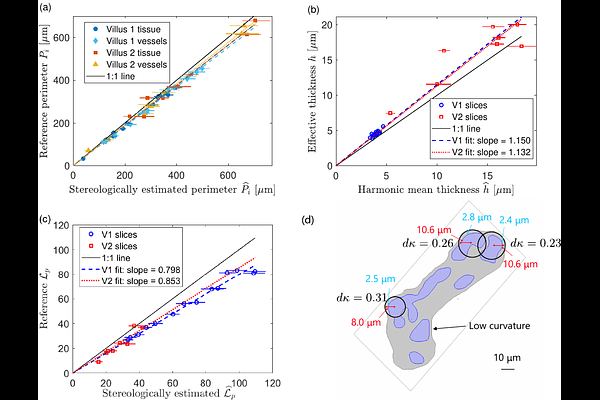
AbstractIntroduction: Stereological estimates of villous membrane thickness and surface area are widely used to infer the diffusive exchange capacity of the human placenta. A key geometric determinant of exchange capacity can be expressed as an effective diffusive length scale. Here we combine virtual histological sections with computational modelling in realistic villous geometries to assess the accuracy of classical stereological estimates of this diffusive length scale. Methods: Two terminal villi, reconstructed from three-dimensional imaging, were digitally sectioned to generate random two-dimensional geometries containing fetal capillaries and surrounding villous tissue. For each section, we simulated steady diffusive transport between the fetal capillary and intervillous space boundaries to obtain a physics-based diffusive length scale as a reference case. Using the same geometries, we applied standard line--intercept stereology to measure harmonic-mean barrier thickness and boundary--length densities, from which a stereological estimate of diffusive length scale was derived. Results: Across both villi, stereology systematically overestimated the diffusive length scale by approximately 15-25%, depending on villus and section. We identified sources of this discrepancy, including interface curvature and assumptions underpinning the stereological correction factors, using idealised models of villus structure. Conclusion: These findings highlight the need for stereological approaches that account for curvature when interpreting placental structure--function relationships.