SKILLFOUNDRY: Building Self-Evolving Agent Skill Libraries from Heterogeneous Scientific Resources

SKILLFOUNDRY: Building Self-Evolving Agent Skill Libraries from Heterogeneous Scientific Resources
Shuaike Shen, Wenduo Cheng, Mingqian Ma, Alistair Turcan, Martin Jinye Zhang, Jian Ma
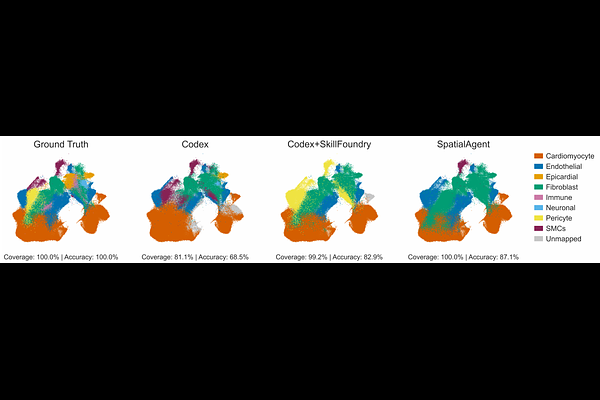
AbstractModern scientific ecosystems are rich in procedural knowledge across repositories, APIs, scripts, notebooks, documentation, databases, and papers, yet much of this knowledge remains fragmented across heterogeneous artifacts that agents cannot readily operationalize. This gap between abundant scientific know-how and usable agent capabilities is a key bottleneck for building effective scientific agents. We present SkillFoundry, a self-evolving framework that converts such resources into validated agent skills, reusable packages that encode task scope, inputs and outputs, execution steps, environment assumptions, provenance, and tests. SkillFoundry organizes a target domain as a domain knowledge tree, mines resources from high-value branches, extracts operational contracts, compiles them into executable skill packages, and then iteratively expands, repairs, merges, or prunes the resulting library through a closed-loop validation process. SkillFoundry produces a substantially novel and internally valid skill library, with 71.1\% of mined skills differing from existing skill libraries such as SkillHub and SkillSMP. We demonstrate that these mined skills improve coding agent performance on five of the six MoSciBench datasets. We further show that SkillFoundry can design new task-specific skills on demand for concrete scientific objectives, and that the resulting skills substantially improve performance on two challenging genomics tasks: cell type annotation and the scDRS workflow. Together, these results show that automatically mined skills improve agent performance on benchmarks and domain-specific tasks, expand coverage beyond hand-crafted skill libraries, and provide a practical foundation for more capable scientific agents.