JWST spectroscopy of SN 2010da/NGC 300 ULX-1: a surviving star hidden by dust

JWST spectroscopy of SN 2010da/NGC 300 ULX-1: a surviving star hidden by dust
Emma R. Beasor, Ryan Lau, Nathan Smith, Dominic J. Walton, Marianne Heida, Ben Davies
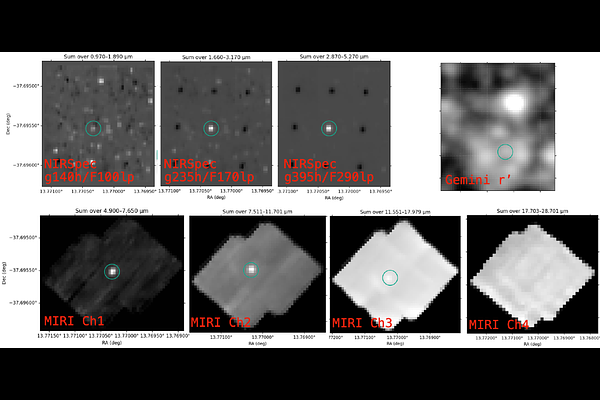
AbstractWe present new James Webb Space Telescope ($JWST$) NIRSpec and MIRI integral-field spectroscopy of the remarkable system SN~2010da / NGC~300 ULX-1, the only known ultraluminous X-ray source powered by a neutron star with a supergiant donor. Our new data, taken in November 2024, reveal that the optical and near-infrared counterpart has dramatically faded since 2018 and no longer exhibits molecular absorption features characteristic of a red supergiant. Instead, the spectral energy distribution shows the donor has returned to its pre-outburst appearance, and is dominated by infrared continuum consistent with an optically thick warm ($\approx$900~K) dust shell. The bolometric luminosity indicates the presence of a surviving luminous source with $\log(L/L_{\odot})=4.11\pm0.02$. Radiative transfer modelling of the mid-infrared spectral energy distribution (SED) reveals a broad emission feature peaking near $\sim$11\,$μ$m, best reproduced by silicon carbide (SiC) dust grains, a composition typically associated with carbon-rich evolved stars. We rule out a failed supernova scenario, which would predict a large drop in luminosity and continued fading. We conclude that the donor star is likely an AGB star that has survived and is now heavily enshrouded - having returned to a dust-obscured state following a transient post-outburst phase in which the system appeared as a red supergiant. We propose a revised evolutionary timeline in which the 2010 outburst initiated sustained super-Eddington accretion and temporarily altered the circumstellar environment. These observations provide rare insight into eruptive mass loss, dust formation, and binary interaction in a unique system.