Chandra and XMM-Newton X-ray Study on the Core-collapse Supernova Remnant N63A in an H II Region

Chandra and XMM-Newton X-ray Study on the Core-collapse Supernova Remnant N63A in an H II Region
Hanxiao Chen, Yang Chen, Lei Sun, Jianbin Weng
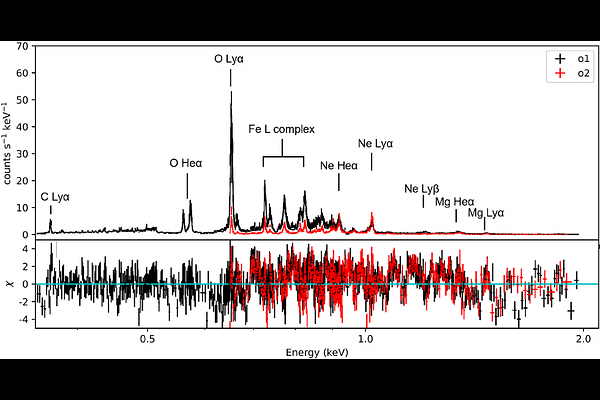
AbstractN63A is one of the brightest supernova remnants (SNRs) in the Large Magellanic Cloud and provides an excellent laboratory for studying SNR evolution in an H II region. We present a detailed X-ray analysis of N63A using Chandra and XMM-Newton observations, combining both imaging and high-resolution spectroscopy. Our global spectral fitting reveals three distinct thermal plasma components with temperatures $kT$$\sim$0.3, 0.7, and 1.5 keV. Spatially-resolved spectroscopy with Chandra shows substantial variations in physical parameters across the remnant, with the eastern lobes of the optical nebula exhibiting significantly higher ionization timescales than the western region. These multi-temperature plasma components indicate that N63A is evolving in a cloudy interstellar medium: the low-temperature component arises from evaporated dense cloudlets that are engulfed by the blast wave, the intermediate-temperature component represents shocked inter-cloud medium, and the highest-temperature component likely results from the shocks reflected by the clouds. We estimate a Sedov age of approximately 4.5 kyr and an explosion energy of about $4\times10^{51}$ erg. Comparison of the observed abundance ratios and masses of metal elements with the nucleosynthesis models constrains the progenitor mass to approximately $20 M_{\odot}$, supporting a single-star core-collapse origin for N63A.