Artificial intelligence as a ploy to delve into the intricate relationship between genetics and mitochondria in MASLD patients

Artificial intelligence as a ploy to delve into the intricate relationship between genetics and mitochondria in MASLD patients
Longo, M.; Paolini, E.; Meroni, M.; Ripolone, M.; Napoli, L.; Gentile, F.; Cespiati, A.; Maggioni, M.; Alisi, A.; Miele, L.; Soardo, G.; Moggio, M.; Fracanzani, A. L.; Dongiovanni, P.
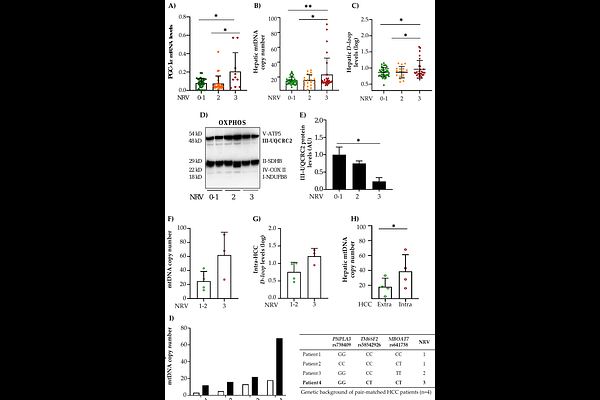
AbstractBackground and Aims: Mitochondrial (mt-) dysfunction is a hallmark of progressive MASLD. MtDNA copy number (mtDNA-CN) and cell-free circulating mtDNA (ccf-mtDNA), which reflect mt-mass and mt-dysfunction, respectively, are gaining attention as non-invasive disease biomarkers. We previously demonstrated that PNPLA3/MBOAT7/TM6SF2 deficiency in HepG2 cells increased mt-mass, mtDNA-CN and ccf-mtDNA. This study furtherly explored mt-biogenesis, function and mt-biomarkers in biopsied MASLD patients from a Discovery (n=28) and a Validation (n=824) cohort, stratified by the number of risk variants (NRV=3). We took advantage of artificial intelligence (AI) to develop new risk scores, predicting MASLD evolution by integrating anthropometric and genetic data (Age, BMI, NRV) with mt-biomarkers. Methods: Hepatic mt-morphology and dynamics were assessed by TEM, IHC and gene expression. mtDNA-CN and ccf-mtDNA were measured in PBMCs and serum samples. GPT-4 was employed as AI tool to support the construction of novel risk scores for MASLD progressive forms (MASH, fibrosis and HCC). Results: In the Discovery cohort, NRV=3 patients showed the highest mt-mass and significant mt-morphological changes (i.e. membranes rupture). An elevated PGC-1, OPA1, DRP1 and PINK1, markers of mt-biogenesis, fusion and fission were found in these patients, supporting an enhanced mt-dynamics. However, PRKN protein levels were reduced, suggesting a premature block of mitophagy. In the Validation cohort, PGC-1 mRNA levels and mtDNA-CN were significantly higher in NRV=3 compared to patients with 1,2 or no variants. Circulating mtDNA-CN and ccf-mtDNA were augmented in NRV=3 patients and correlated with genetics and MASLD severity at multivariate analysis, supporting that both may independently modulate mt-dynamics and activity. By exploiting rsGPT-4 we then optimized the combination of non-invasive variables to get prediction models named Mitochondrial, Anthropometric, and Genetic Integration with Computational intelligence (MAGIC-) for assessing MASH, fibrosis, and HCC, respectively. The MAGIC-MASH and MAGIC-Fib models showed AUCs of 73% and 76% in detecting MASH and fibrosis >1. Of note, MAGIC-HCC achieved an AUC of 86% (95% CI: 0.823-0.885), with 78.6% sensitivity and 81.5% specificity thus resulting the best score for the desired outcome. Conclusions: mtDNA-CN and ccf-mtDNA may have pathological and prognostic significance in MASLD patients, especially in those genetically-predisposed.