Arabidopsis exocyst complex subunit EXO70E2 in defence against Pseudomonas syringae in conjunction with autophagy

Arabidopsis exocyst complex subunit EXO70E2 in defence against Pseudomonas syringae in conjunction with autophagy
Yıldız, A. B.; Potocka, A.; Caldarescu, G. A.; Batik, A.; Sabol, P.; Zarsky, V.
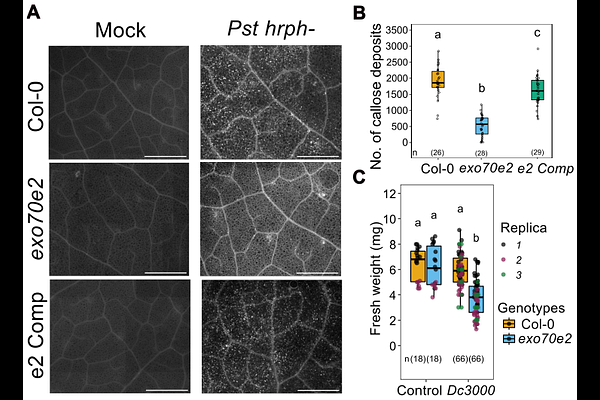
AbstractExocyst was initially uncovered in yeast genetic sec-screen as a tethering complex for exocytotic vesicles and this function was later found to be evolutionarily conserved in other eukaryotes including plants. Later however, a surprising engagement of the exocyst complex in autophagy was observed in animals, plants and recently also in yeast. Using the genetic approach we observed EXO70E2 exocyst complex subunit engagement in the defence response to Pseudomonas syringae attack linked to the autophagy pathway. CRISPR/CAS LOF mutant of EXO70E2 is more sensitive to Pseudomonas infection (both virulent as well as T3SS mutant) and autophagy flux monitored by NBR1 antibody is compromised in comparison to WT. We conclude that the plant exocyst complex linked to the EXO70E2 subunit participates in defence against Pseudomonas bacteria in conjunction with the autophagy pathway. HighlightArabidopsis exocyst subunit EXO70E2 affects selective autophagic flux monitored by NBR1 and is participating in defense against Pseudomonas syringae infection.