High invasion risk of non-native fishes in the lower Tigris Basin (south-west Iran) with special reference to Shadegan International Wetland

High invasion risk of non-native fishes in the lower Tigris Basin (south-west Iran) with special reference to Shadegan International Wetland
Peymani, M.; Valikhani, H.; Abdoli, A.; Nejat, F.; Moghaddas, D.; Vilizzi, L.
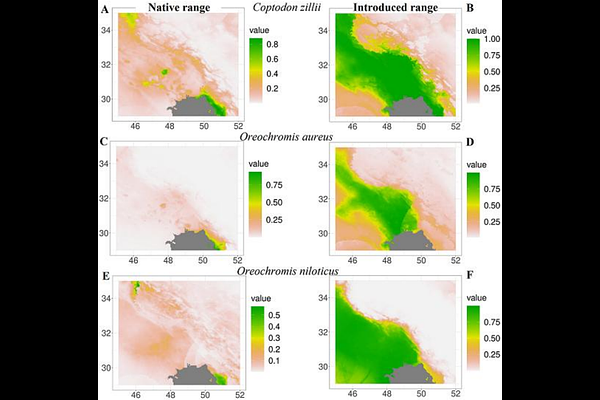
AbstractThe invasiveness risk of 15 non-native freshwater fish species established in the lower Tigris Basin (south-west Iran) was evaluated for Shadegan International Wetland and associated catchments of the Jarrahi and Karun rivers by integrating risk screening with species distribution modelling. Risk identification under both current and projected climate conditions indicated that most taxa pose elevated invasion risk, with 13 species ranked as high risk and two as medium risk under the Basic Risk Assessment, and 11 as high risk, three as medium risk, and one as low risk after incorporating climate change effects. The highest scoring species were redbelly tilapia Coptodon zillii, blue tilapia Oreochromis aureus, and Nile tilapia O. niloticus, each with outcome scores exceeding 40 under both screening components. Species distribution models for these taxa showed good predictive performance and indicated broad climatic suitability across the lower basin, with projections based on non-native occurrences suggesting a substantially wider potential distribution than projections based on native range data. Collectively, these findings indicate a high likelihood of continued spread and ecological impact within this internationally important wetland system and support the need for coordinated transboundary management to strengthen monitoring, early detection, rapid response, and strategic control of potentially invasive species.