Engineering quantitative root disease resistance in barley by targeting conserved SCAR susceptibility genes without compromising seed yield or mycorrhizal symbiosis

Engineering quantitative root disease resistance in barley by targeting conserved SCAR susceptibility genes without compromising seed yield or mycorrhizal symbiosis
Brumm, S.; Macleod, M.; Coven, I.; Hernandez-Pinzon, I.; Evangelisti, E.; Mueller, M. C.; Moscou, M. J.; Schornack, S.
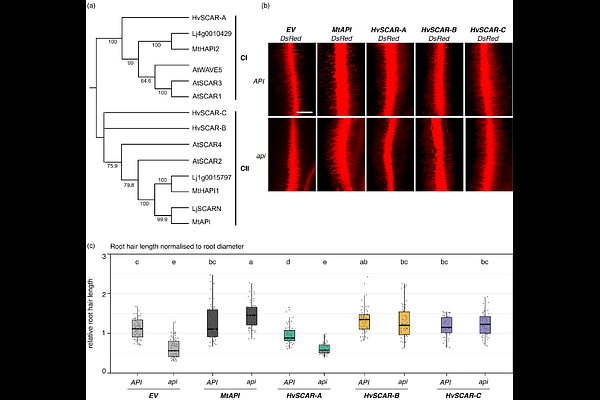
AbstractDurable resistance to soil-borne pathogens remains elusive in cereals, partly because susceptibility (S) genes that facilitate root infection have not been identified in monocots. In the model legume Medicago truncatula, the SCAR/WAVE complex member MtAPI functions as a root S-gene for microbial invasion. Whether SCAR gene associated susceptibility function is conserved in monocots, and whether SCAR gene inactivation can enhance root resistance in cereals, remains unknown. Here, we identify and characterize three SCAR genes in barley: HvSCAR-A, HvSCAR-B, and HvSCAR-C. Cross-species complementation assays indicate that HvSCAR-B and HvSCAR-C are functionally similar to MtAPI. While hscar-b and hvscar-c single mutants exhibited no major growth defects, hvscar-a mutants showed strongly reduced seed production, and a hvscar-b/c double mutant displayed shorter root hairs. Notably, the hvscar-b/c double mutant exhibited increased resistance to the hemibiotrophic pathogen Phytophthora palmivora but greater colonization by the symbiotic arbuscular mycorrhizal fungus Funneliformis mosseae, underscoring a complex role in plant root - microbe interactions. Our findings reveal a conserved susceptibility function of SCAR genes in monocots and identify api monocot homologs as promising targets for engineering disease resistance in cereals. This study offers new insights into SCAR protein functional diversification and its potential for improving root health in crop plants.