Decomposing response inhibition: a POMDP model

Decomposing response inhibition: a POMDP model
Wang, W.; Kaufmann, T.; Dayan, P.
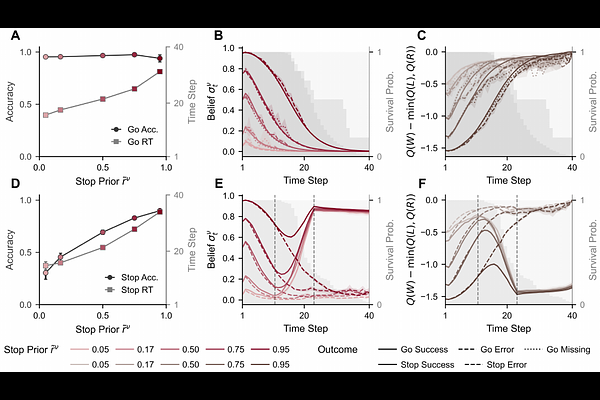
AbstractInhibition is a core cognitive control function whose competence is distributed across the population, with more extreme impairments in psychiatric conditions such as attention deficit hyperactivity disorder (ADHD). The Stop Signal Task (SST) is a widely used paradigm for assessing this ability. However, conventional formalizations of SST performance, such as the independent race model, rely on assumptions that are frequently violated in modern experimental designs. Furthermore, the typical focus is on fitting mean reaction times, overlooking trial-by-trial dynamics. To address these limitations, we model the SST as a partially observable Markov decision process. This framework characterizes inhibitory control through distinct components: noisy perceptual inference regarding stimuli, and optimal control balanced against potential costs. To assess the ability of the model to capture the distribution of inhibitory capacities, we fit it to data from the large Adolescent Brain Cognitive Development (ABCD) study baseline cohort (N = 5,114). To do this, we adapted Simulation-Based Inference with a transformer-based encoder. This architecture learns compact, sequence-aware embeddings from raw behavioral data. These embeddings enable amortized inference of individual-level parameter posteriors in an efficient and reliable end-to-end manner, as confirmed by extensive validation. We identified distinct computational phenotypes associated with ADHD traits. Children with higher ADHD scores exhibited greater directional imprecision, a diminished intrinsic penalty for inhibition failures, and a more deterministic response style. Notably, the learned embedding space reveals a continuous manifold where children with the higher ADHD scores are heterogeneously distributed, rather than forming distinct disorder clusters. This indicates that similar clinical traits can emerge from diverse combinations of computational mechanisms, supporting a dimensional perspective on neurodiversity. Our framework can be extended to a broader range of cognitive tasks, offering a scalable solution for fitting complex models to large-scale behavioral data.