A Minimal Interpretation of the Galactic Cosmic-Ray Spectrum from GeV to PeV Energies

A Minimal Interpretation of the Galactic Cosmic-Ray Spectrum from GeV to PeV Energies
Felix Aharonian, Bing Theodore Zhang
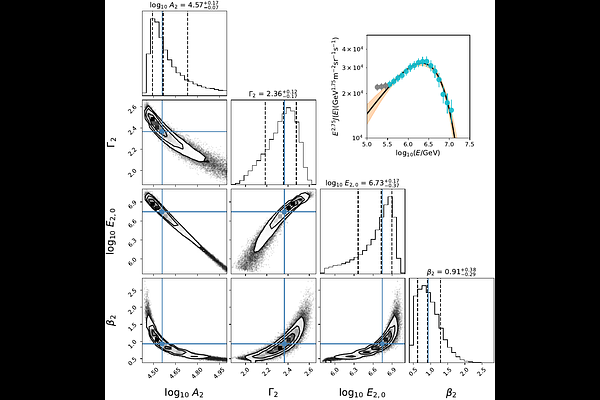
AbstractHigh-precision measurements of the cosmic-ray (CR) proton spectrum have revealed significant deviations from a simple power-law behaviour. These deviations are characterised by three prominent features: (i) a progressive spectral hardening above approximately 200 GeV, (ii) an excess between 10 and 30 TeV (the ``multi-TeV bump''), followed by a sharp turnover around 100 TeV, and (iii) a pronounced structure between 0.1 and 10 PeV (the ``PeV bump''). We propose a minimal two cosmic-ray population framework that consistently accounts for the observed CR proton spectrum across six decades in energy, from GeV to PeV. In this scenario, the spectral complexity arises naturally from a transition between two Galactic CR proton populations in the 10-100 TeV energy range. The low-energy population exhibits a sharp cutoff at tens of TeV, while a second, higher-energy population emerges and dominates above 100 TeV, terminating with a smooth exponential cutoff at approximately 6.5 PeV. This framework reproduces all observed spectral features without invoking contributions from nearby sources or requiring non-standard assumptions about particle acceleration or propagation. Recent gamma-ray observations of supernova remnants, star-forming regions, and microquasars provide plausible astrophysical candidates for the origin of the two CR components.