Non-invasive brain stimulation biases temporal value-aversiveness computations and promotes sustainable decision-making

Non-invasive brain stimulation biases temporal value-aversiveness computations and promotes sustainable decision-making
Zhang, X.; Liu, W.
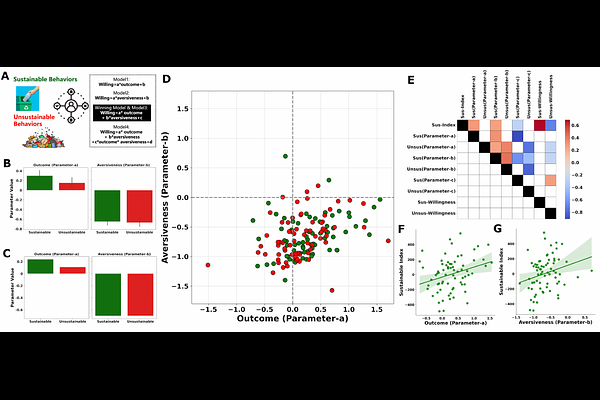
AbstractEnvironmental sustainability depends on widespread adoption of sustainable behaviors, yet the neurocomputational mechanisms supporting such choices remain poorly understood. We developed a temporal-value decision model (TVDM) to explain sustainability-related decision-making. Behavioral data showed that sustainable decisions often carry immediate aversiveness while associated outcome values that are delayed and therefore discounted, jointly limiting sustainable decisions. We replicated these effects in an independent sample and then investigated whether these mechanisms could be externally influenced. Non-invasive transcranial direct current stimulation (tDCS) targeting the dorsolateral prefrontal cortex (DLPFC) increased sustainability and this behavioral shift was accompanied by higher overall outcome valuation, reduced aversiveness, and a selective level shift for the discounting function for outcomes (but not for aversiveness). These effects were absent under sham stimulation and an active control condition. Together, the findings indicate that sustainable behavior is constrained by a temporally structured value-aversiveness conflict yet can be shifted via non-invasive brain stimulation.