A pooled image-based CRISPR screen identifies EAF1 as a T. gondii modulator of ESCRT subversion.

A pooled image-based CRISPR screen identifies EAF1 as a T. gondii modulator of ESCRT subversion.
Olafsson, E. B.; Arnold, C.-S.; Kellermeier, J. A.; Rimple, P.; Kaur, H.; Wang, Y.; Sexton, J. Z.; Svard, S.; Carruthers, V. B.; O'Meara, M.
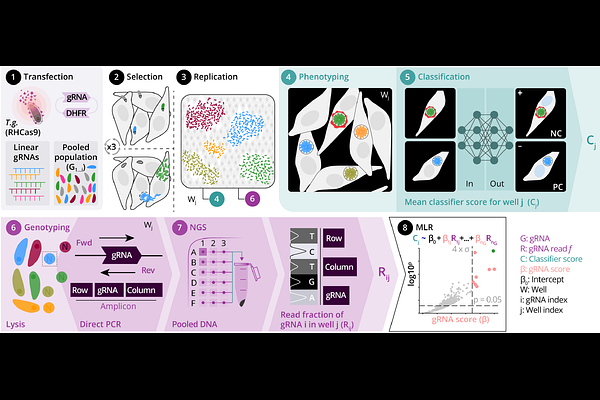
AbstractIntracellular pathogens remodel host cells by redirecting cellular machinery to the host-pathogen interface. The protozoan parasite Toxoplasma gondii co-opts host ESCRT proteins at the parasitophorous vacuole membrane (PVM), where they support budding of host-derived vesicles into the vacuole. Yet the parasite effectors that direct this process remain largely unknown. Here we developed spaCR (spatial phenotype analysis of CRISPR-Cas9 screens), a pooled image-based screening framework that combines deep-learning classification of single-cell spatial phenotypes with well-level barcode genotyping and regression-based deconvolution of gene effects. Screening T. gondii secretory proteins recovered the known TSG101 recruiter GRA14 and identified an uncharacterised effector, ESCRT-association factor 1 (EAF1), that promoted TSG101 recruitment to the PVM. Targeted deletion confirmed its role across Type I and II lineages, and IP-MS recovered ESCRT-I and ESCRT-III components, including TSG101. Together, these findings identify EAF1 as an ESCRT-associated parasite effector and establish spaCR as a general framework for linking CRISPR perturbations to spatial phenotypes.