Temporal Gatekeeping Role of Lmx1 during chordate neural tube morphogenesis

Temporal Gatekeeping Role of Lmx1 during chordate neural tube morphogenesis
Perez-Benitez, J.; Levine, M.; Lemaire, L. A.
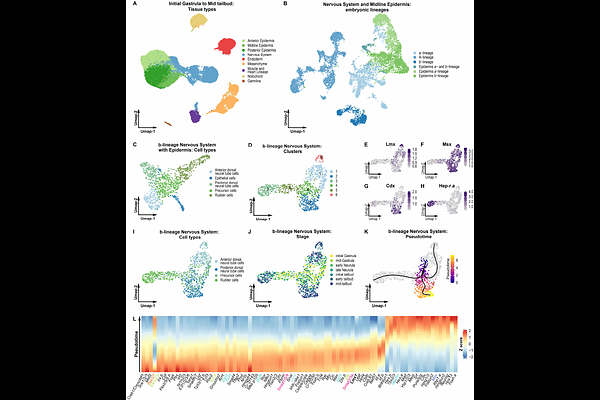
AbstractNeural tube closure is a critical developmental process, essential to the proper formation of the vertebrate nervous system. This process starts with the invagination of neural plate cells. Its borders then converge, leading to the closure of the neural tube, propagating like a zipper. Afterwards, cell intercalation and proliferation allow the tube to elongate. Neural tube closure involves thousands of cells in vertebrates. However, the closest invertebrates to vertebrates, the tunicates, such as Ciona, close a hollow dorsal neural tube with fewer than 20 neural cells. This minimal model makes it easier to study the mechanisms of this intricated process. In Ciona, the transcription factor Lmx1 is expressed in the most dorsal cells of the developing neural tube, like its vertebrate orthologs. In vertebrates, Lmx1 paralogs are involved in neural tube patterning. However, no function related to morphogenesis has been uncovered. Here, we explore Ciona Lmx1 roles during neural tube closure. Lmx1 Knockdown leads to slight but significant defects in neural tube closure. The overexpression of a repressive Lmx1 variant prevents the proper intercalation of the dorsal neural tube cells, impeding the anterior progression of the zipper. Furthermore, studies of Lmx1 regulatory sequences indicate that Pax3/7, ZicL, and Nodal signaling may directly regulate its transcription. These transcription factors are present at the vertebrate neural plate border, suggesting that Lmx1 regulation is conserved across chordates. It raises the possibility of an unrecognized role for Lmx1 during vertebrate neural tube morphogenesis.