Rapid jet ejection from PKS 0215+015 coincident with a high-energy neutrino event

Rapid jet ejection from PKS 0215+015 coincident with a high-energy neutrino event
F. Eppel, M. Kadler, E. Ros, P. Benke, L. C. Debbrecht, J. Eich, P. G. Edwards, M. Giroletti, A. Gokus, S. Hämmerich, J. Heßdörfer, M. Janssen, S. Kim, D. Kirchner, Y. Y. Kovalev, T. P. Krichbaum, R. Ojha, G. F. Paraschos, F. Rösch, W. Schulga, J. Sinapius, J. Stevens
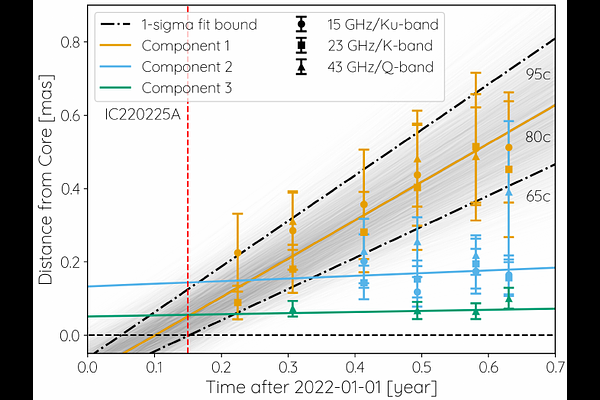
AbstractAims. We present a new neutrino-blazar multiwavelength flare coincidence observed in the blazar PKS 0215+015, which showed a strong multiwavelength outburst in coincidence with the IceCube neutrino track alert IC220225A, similar to the case of TXS 0506+056. We investigate the immediate response of the radio jet to the major flare. Methods. We performed target-of-opportunity observations with the Very Long Baseline Array (VLBA) at 15, 23, and 43 GHz in full polarization for six epochs with monthly cadence following the neutrino event. We combine the VLBA observations with monitoring data from the Effelsberg 100-m telescope, the Australia Telescope Compact Array, and Fermi/LAT. Results. Based on our VLBI kinematic analysis, we identified a new rapid jet component with an apparent speed of ~60-80c, which was ejected around the arrival of IC220225A. The fast component ejection is traced by a characteristic signature in polarization that suggests a shock-shock interaction with a quasi-stationary feature. By combining the VLBI results with radio variability data, we estimated a bulk Lorentz factor of $Γ= 105 \pm 56$ and a jet viewing angle of $\vartheta = (1.47 \pm 0.31)^\circ$. Conclusions. We note that the properties of the rapid component exceed previously reported maximum apparent jet speeds and Lorentz factors from continuous VLBI monitoring programs. This is likely only possible because we are observing an exceptional flaring event at high redshift (z=1.72) with higher observing cadence than in typical monitoring programs. We suggest that neutrino production in PKS 0215+015 can occur through pγ-interactions with protons possibly accelerated within the fast-moving feature. The target photon field could be external to the jet or explained by a multi-layered jet. The latter scenario is consistent with the presence of quasi-stationary features revealed in our analysis.