Chd8 haploinsufficiency leads to molecular layer heterotopias and age-dependent cortical expansion

Chd8 haploinsufficiency leads to molecular layer heterotopias and age-dependent cortical expansion
Kyere, F.; Curtin, I.; Wei, Z.; Yin, M.; Xing, L.; Wen, T.; Vlasova, R.; Li, K.; Matoba, N.; McCormick, C.; Farah, T.; Krupa, O.; Glass, M.; Taylor-Blake, B.; McCoy, E.; Tzu-Wen, W. W.; He, Q.; Dere, M.; D'Arcy, B.; Davis, L.; Dayananda, V.; Escobar-Tomlienovich, C.; Eswar, K.; Moghul, M.; Yeturi, M.; Huang, K.; Baldonado, M.; Kaikini, M.; Silver, D.; Borland, D.; Yi, H.; Ariel, P.; Shih, I.; Zylka, M. J.; Wu, G.; Stein, J. L.
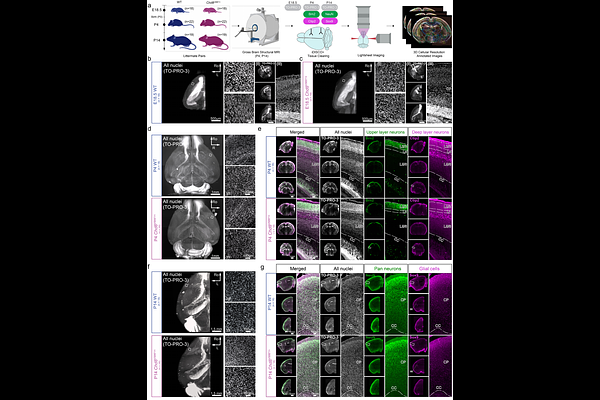
AbstractMutations in the chromatin remodeler CHD8 are associated with autism and macrocephaly. While mouse models of Chd8 haploinsufficiency recapitulate brain overgrowth, the specific cellular mechanisms and developmental timing that lead to these anatomical abnormalities remain poorly understood. Here, we conducted 3D imaging of Chd8V986*/+ mouse brains using magnetic resonance imaging followed by tissue clearing and cellular resolution light-sheet microscopy across embryonic and postnatal developmental stages. We found that brain overgrowth occurs postnatally, driven by an expansion of oligodendrocytes and microglia. Unexpectedly, we identified prevalent molecular layer heterotopias within the frontal cortex of Chd8V986*/+ mice appearing during embryonic development and persisting throughout life. Molecular layer heterotopias were previously identified in post-mortem brains from individuals with autism and other neurodevelopmental disorders, suggesting functional significance in human patients.