Characterising AlphaFold 3s ability to predict T cellantigen specificity

Characterising AlphaFold 3s ability to predict T cellantigen specificity
McMaster, B.; Elmoselhy, A.; Ilievski, I.; Thorpe, C. J.; La Gupta, N. L.; Rossjohn, J.; Deane, C.; Koohy, H.
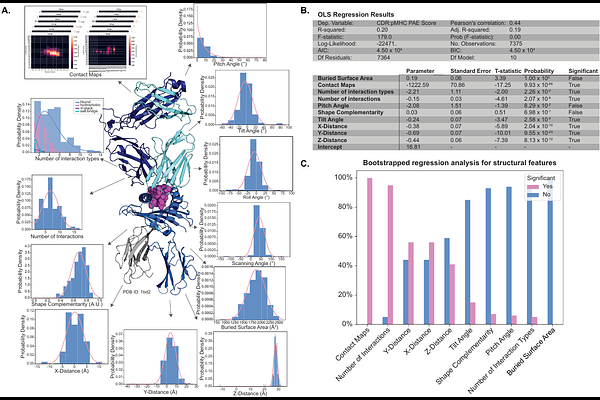
AbstractT cells are a key part of the adaptive immune system. Using their surface-bound T cell antigen receptors (TCRs), these cells scan peptides and other antigens presented to them by major histocompatibility complex molecules (MHCs) on the surface of cells, searching for abnormalities. Although determining the map between TCRs and their target antigens is of vital importance for the design of safe and effective T cell-based vaccines and therapeutics, decoding these interactions is challenging. Experimental methods are not scalable, and sequence-based computational methods have issues generalising to new antigens. The IMMREP25 benchmark of methods for predicting T cell antigen specificity showed that AlphaFold-based methods promise improved generalisation to novel antigens. However, the ability of structure prediction models to predict T cell antigen specificity has not been robustly evaluated previously. In this work, we characterise AlphaFolds ability to predict T cell antigen specificity. We created a pipeline for high-throughput prediction of TCR:peptide-MHC (pMHC) structures using AlphaFold that is > 100 fold faster than the default implementation and used it to benchmark AlphaFold 3 (AF3) and similar models at predicting T cell antigen specificity. We investigated the underlying correlates of AlphaFold-derived binding scores and found that the models predictive power is related to the positioning of TCRs over the pMHC and not chemical interactions. Furthermore, we refine the AlphaFold-derived binding scores by training a machine learning model we call the PAE Aggregator. We then investigate AF3s ability to uncover the clustering rules of TCR repertoires and recapitulate mutational scanning experiments. These analyses show that AlphaFold3 clusters sequence-similar TCRs according to their binding mode and detects disrupting point mutations accurately. Our results highlight both the promise and the current limitations of structure-based approaches for predicting TCR specificity, guiding the development of more reliable immunological prediction methods.