Degree heating weeks fail to reach alert thresholds yet coral bleaching is widespread: structural insensitivity of anomaly-based metrics across Japan's latitudinal gradient

Degree heating weeks fail to reach alert thresholds yet coral bleaching is widespread: structural insensitivity of anomaly-based metrics across Japan's latitudinal gradient
Fukui, H.
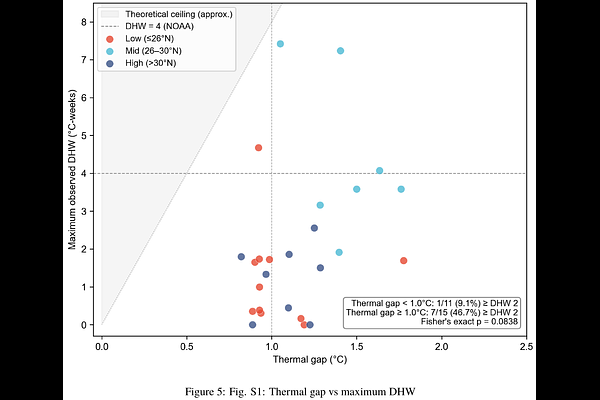
AbstractDegree Heating Weeks (DHW) is the standard metric for global coral bleaching prediction, yet its performance varies markedly across regions for unexplained reasons. We analyse five years (2020-2024) of standardised bleaching surveys from Japan's Monitoring Site 1000 program (26 sites, 113 site-years; balanced panel n = 105) across a 24-35 degrees N gradient to diagnose why DHW fails in subtropical waters. Only 4 of 113 site-years (3.5%) reached the DHW >= 4 alert threshold, while bleaching (>0%) was recorded in 65 site-years (57.5%). DHW sensitivity for detecting any bleaching was 6.2%. A simple absolute-temperature metric (days with SST >= 30 degrees C) outperformed DHW in discriminating >=50% bleaching (AUC = 0.926 vs 0.667, DeltaAUC = 0.260, 95% CI [0.154, 0.355], p < 0.001), largest at low latitudes (DeltaAUC = 0.293, p < 0.001). The Maximum Monthly Mean (MMM) was strongly correlated with latitude (r = -0.914), compressing the thermal gap available for HotSpot accumulation at low-latitude sites and eliminating HotSpot events at high-latitude sites. This structural insensitivity -- arising from the anomaly-based design of DHW rather than from threshold miscalibration -- operated through two distinct mechanisms across the latitudinal gradient. At low latitudes, where MMM approaches 30 degrees C, HotSpot signals were compressed below detection thresholds despite widespread bleaching; at high latitudes, SST rarely exceeded MMM, rendering HotSpot events absent altogether. These findings demonstrate that DHW's standard alert framework is structurally non-functional across Japan's coral monitoring network and that regional assessment requires metrics independent of the MMM-relative anomaly architecture.