Inference of recoil kicks from binary black hole mergers up to GWTC--4 and their astrophysical implications

Inference of recoil kicks from binary black hole mergers up to GWTC--4 and their astrophysical implications
Tousif Islam
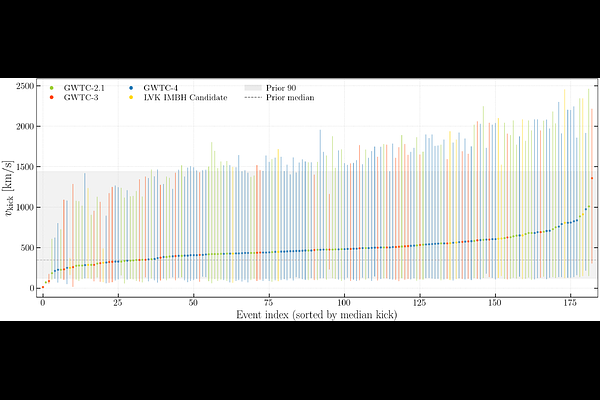
AbstractWe infer recoil (kick) velocities for all binary black hole merger events reported up to the GWTC--4 catalog, together with candidate intermediate-mass black hole events. We obtain informative kick constraints for GW231028\_153006 ($839^{+1018}_{-681}\,\mathrm{km\,s^{-1}}$) and GW231123\_135430 ($974^{+944}_{-760}\,\mathrm{km\,s^{-1}}$). Additionally, we compute recoil velocities for recently reported events from the ongoing fourth observing run: GW241011\_233834, GW241110\_124123, and GW250114\_082203, obtaining $v_{\rm kick} = 974^{+555}_{-466}\,\mathrm{km\,s^{-1}}$, $394^{+582}_{-207}\,\mathrm{km\,s^{-1}}$, and $115^{+301}_{-95}\,\mathrm{km\,s^{-1}}$, respectively. The remnant of GW241011\_233834 is therefore inferred to have one of the largest recoil velocities among currently known events. We find that present recoil kick constraints are driven primarily by measurements of the mass ratio and spin magnitudes, while the contribution from spin orientation angles remains subdominant in most cases. We estimate typical retention probabilities of the remnant black holes in GWTC catalogs to be $\sim 1$--$5\%$ for globular clusters, $\sim 15$--$30\%$ for nuclear star clusters, $\sim 5$--$40\%$ for dwarf galaxies, and $\sim 70$--$100\%$ for elliptical galaxies. We further show that, even for remnants retained in globular clusters, recoil-induced spatial displacements from the cluster core are often significant, which can substantially suppress the chances of hierarchical mergers. We find that the probability for a GWTC merger remnant to participate in hierarchical mergers is $\sim 0.1$--$1\%$ in globular clusters and $\sim 1$--$15\%$ in nuclear star clusters.