Interactome mapping in human excitatory neurons reveals novel risk genes and pathways in Alzheimer's disease

Interactome mapping in human excitatory neurons reveals novel risk genes and pathways in Alzheimer's disease
Wei, X.; Munechika, K.; Sun, Y.; Wan, Y.; Xia, T.; Hou, Y.; Song, W.; Yugandhar, K.; Wang, Y.; Lee, S.-I.; Sha, Z.; Zhou, Y.; Feng, W.; Zhu, J.; Tang, Y.; Luo, W.; Cheng, F.; Gan, L.; Yu, H.
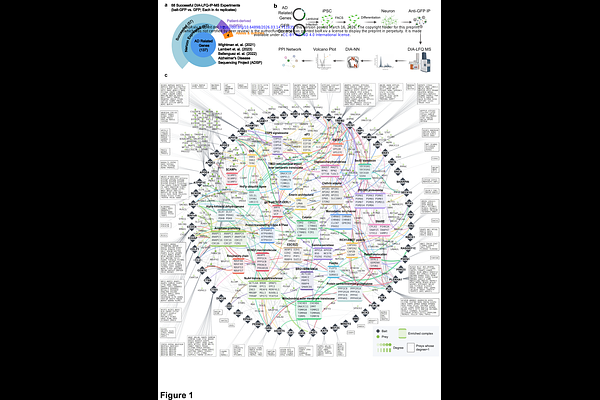
AbstractAlzheimer's disease (AD) is an irreversible neurodegenerative disease defined by its molecular hallmarks - amyloid beta peptide plaques and neurofibrillary Tau tangles. Despite significant progress that has been made in uncovering a large number of genetic risk factors through extensive genomic sequencing and genetic studies, the molecular mechanisms driving AD-associated pathology and cognitive decline remain poorly understood. Therefore, alongside the identification of more risk genes, it is also paramount to study how these genes function and influence each other within the cellular pathways and overall molecular networks in AD-relevant brain cell types. However, current human protein-protein interactome datasets were all generated in either yeast or generic human cell lines. Consequently, many important neuronal interactions, especially neuron-specific ones, have yet been discovered. To address this critical gap, we developed a highly scalable, high-quality interactome mapping pipeline in human excitatory neurons derived from induced pluripotent stem cells (iPSC), and generated a comprehensive, neuron-specific interactome map, named ADNeuronNet, for key AD risk genes. ADNeuronNet consists of 1,767 high-confidence interactions among 1,189 proteins and is the only dataset enriched with neuron-specific genes when compared to known protein interactions, including previous large-scale interactome maps, for the same baits in the literature. Within ADNeuronNet, we identified 1,375 novel interactions, many of which are likely neuron specific. For example, we identified a neuron-specific interactor, RIN2, for major AD risk factor BIN1 and confirmed RIN2's function in recruiting BIN1 to RAB5 positive early endosomes, a process that has been well-associated with AD etiology. Additionally, we performed quantitative interaction perturbation analyses on AD risk genes with AD-associated mutations or isoforms and identified significant changes in 99 protein interactions among 11 different protein variants. Finally, we found that subunits from the anaphase-promoting complex/cyclosome (APC/C), another novel BIN1 interactors identified by ADNeuronNet, mediated modulation of Tau-aggregation in neurons via regulation of APOE expression, uncovering a previously unrecognized BIN1-APC/C-APOE regulatory axis in AD pathobiology. In summary, these findings illustrate how our neuron-specific ADNeuronNet can be leveraged to uncover new risk gene candidates and cellular pathways that help advance our understanding of molecular mechanisms underlying AD etiology.