Reconstructing the demographic history of blacklegged ticks (Ixodes scapularis) in the northern United States

Reconstructing the demographic history of blacklegged ticks (Ixodes scapularis) in the northern United States
Dong, D.-y.; Schoville, S. D.
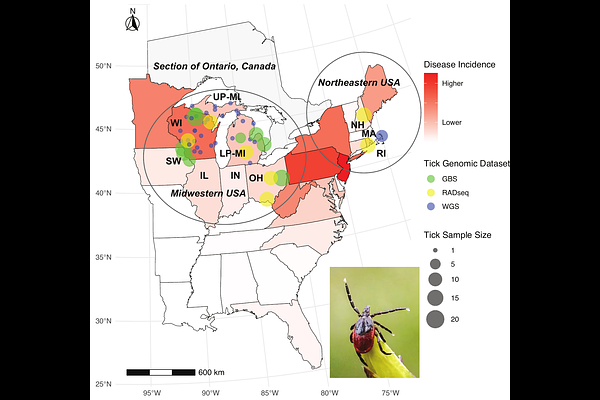
AbstractAim: To resolve the topological branching patterns, the timing of demographic events, and the effective population size changes associated with major demographic events. Location: Midwestern (eastern North Central) and Northeastern USA Taxon: Blacklegged tick, Ixodes scapularis (Say, 1821) Methods: Using three independent genomic datasets, single-nucleotide variants were analyzed for demographic inference. Maximum likelihood topologies and prior ecological knowledge were used to generate nested demographic hypotheses. The best-fit scenario and the associated demographic parameter estimates were determined using approximate Bayesian computation under a random forest statistical model. The topologies and parameters supported in the three independent datasets were compared to generate insights about the demographic history of blacklegged ticks in the region. Results: The emergence of extant northern populations of blacklegged ticks began between 10-15 k.y.a. (thousand years ago), with independent population splits from the common ancestor during the Early-Mid-Holocene, and never more recent than 4 k.y.a. All populations sustained moderately large population sizes without bottlenecks, with Michigan as the exception. Michigan appears to have an uncertain placement that depends on sampling, reflecting its admixed origin. Main conclusions: There are multiple populations of northern blacklegged ticks that have persisted independently as deglaciated regions in the northern U.S. were recolonized following the Last Glacial Maximum (26.5 to 19 k.y.a.). The current ecological expansions across the northern U.S. are likely seeded by separate relictual populations with distinctive genomic ancestry rather than a range expansion from a single source, with important implications for vector-borne disease management.