Arachidonic acid availability controls neutrophil swarm initiation and scaling

Arachidonic acid availability controls neutrophil swarm initiation and scaling
Strickland, E. D.; Kandaswamy, R.; Zager, P. J.; De Belly, H.; Phillips, T. K.; Hopke, A.; Weiner, O. D.
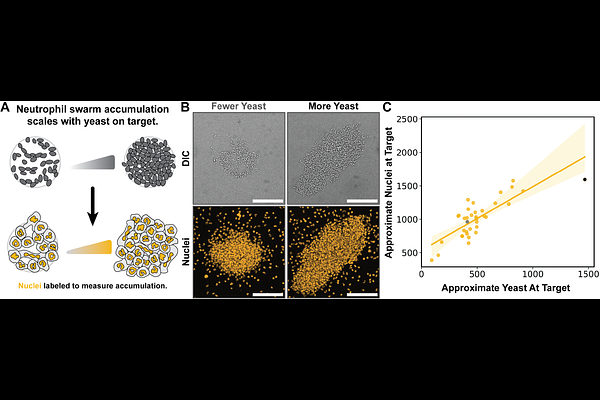
AbstractNeutrophils are first responders of the vertebrate immune system. To efficiently converge on sites of injury and infection, neutrophils engage in a collective migration process known as swarming, in which a small number of activated cells generate amplified recruitment of hundreds to thousands of additional neutrophils. How neutrophils initiate, scale, and terminate these swarms is not well understood. Here we define key roles for the mechanosensitive phospholipase cPLA2 and its product, arachidonic acid (AA), in swarm initiation and scaling. We observe that swarm-initiating neutrophils satisfy the conditions for cPLA2 activation through two coincident inputs: yeast-contact-mediated Ca2+ influx and nuclear stretch following cell spreading along fungal hyphae and clusters. This co-requirement for both chemical and physical features of pathogens may explain how neutrophils restrict swarming to insults that require collective action. We further demonstrate that AA release is necessary and sufficient for swarming and that AA levels regulate swarm magnitude. We propose that neutrophils share AA across multiple yeast-engaged cells to collectively assess infection magnitude. Because calcium influx, nuclear deformation, and cPLA2-mediated AA generation are also features of sterile-injury inflammatory responses, our findings suggest a unifying circuit for swarm regulation across injury and infection contexts.